The demand for SEO professionals is growing faster than ever before. As businesses continue investing in digital marketing, companies need skilled SEO Executives, SEO Analysts, SEO Interns, and Digital Marketing professionals who can improve website visibility, increase organic traffic, and generate business growth through search engines.
If you are preparing for your first SEO interview, you have probably searched for SEO Interview Questions for Freshers multiple times. While many websites only provide short definitions, modern interviews in 2026 focus on practical knowledge, problem-solving skills, AI-powered search optimization, and your ability to apply SEO techniques in real-world situations.
Today’s SEO is very different from what it was a few years ago. Google now uses advanced artificial intelligence, machine learning, natural language understanding, entity recognition, and user behavior signals to deliver better search results. Features like AI Overviews, multimodal search, voice search, zero-click searches, and personalized search experiences have changed how websites rank. Because of these changes, recruiters expect freshers to understand both traditional SEO concepts and modern AI-driven SEO strategies.This guide includes practical Interview Questions for Search Engine Optimization for Beginner candidates preparing for their first SEO job.
The good news is that companies do not expect beginners to know everything. Instead, interviewers want to see that you understand SEO fundamentals, know how search engines work, can use essential SEO tools, and are eager to learn. If you can explain concepts clearly with practical examples, you already have a strong advantage over candidates who only memorize textbook definitions.
Preparing for an SEO interview is also about building confidence. Reading Google Search documentation, practicing with tools like Google Search Console and Google Analytics 4, creating a small personal website, and optimizing content yourself will help you answer questions naturally during interviews. Recruiters appreciate candidates who have experimented with SEO rather than only studied theory.If you’re completely new to SEO, our Digital Marketing Course in Ahmedabad will help you learn practical SEO through live projects.
Artificial Intelligence is also becoming an important part of SEO workflows. Tools such as ChatGPT, Gemini, Claude, and Perplexity can help with keyword research, content planning, technical audits, and content optimization. However, companies still value human creativity, strategic thinking, and ethical SEO practices. Knowing how to use AI responsibly alongside SEO best practices is now a valuable skill for freshers.
This comprehensive guide covers the latest SEO Interview Questions for Freshers, including SEO fundamentals, keyword research, on-page SEO, technical SEO, off-page SEO, analytics, AI-powered SEO, and modern search optimization techniques. Every answer is written in simple English, includes practical insights, and reflects the latest Google Search trends for 2026.
Whether you are a BCA student, BBA graduate, MBA student, engineering graduate, commerce student, career switcher, internship applicant, or aspiring SEO Executive, this guide will help you prepare smarter and perform confidently in interviews.
Why SEO Interview Questions for Freshers Are Important in 2026
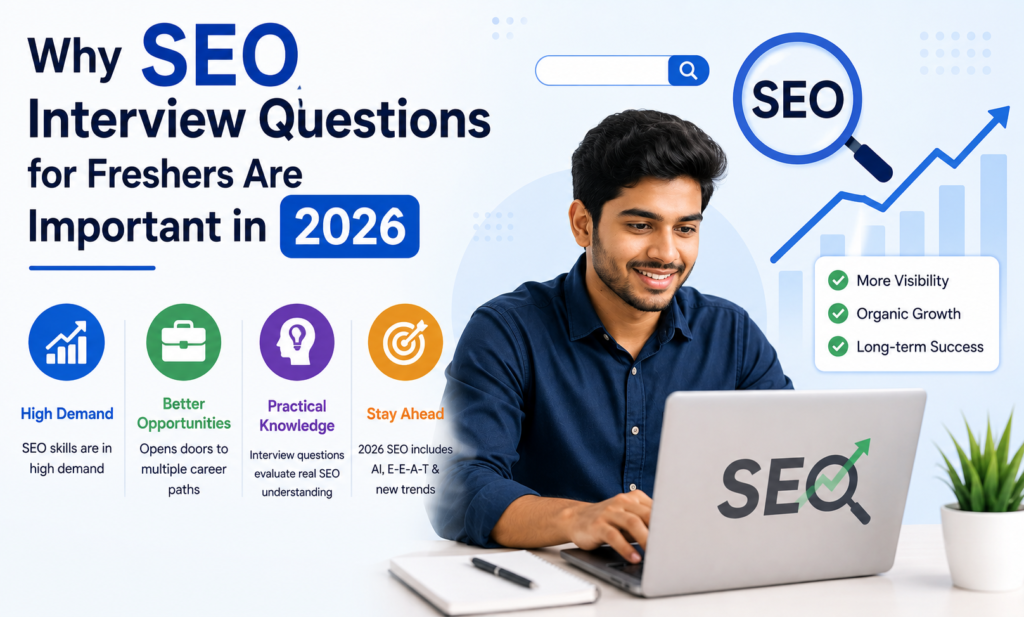
SEO has become one of the most sought-after skills in digital marketing because almost every business wants to grow its online presence. From startups and local businesses to multinational companies and e-commerce brands, organizations rely on SEO professionals to attract qualified visitors from search engines without paying for every click.
Growing Demand Across Industries
SEO professionals are needed in:
- Digital marketing agencies
- IT companies
- E-commerce businesses
- SaaS companies
- Healthcare organizations
- Educational institutions
- Real estate firms
- Manufacturing companies
- Travel and hospitality businesses
- News and media platforms
With businesses expanding their online presence globally, SEO skills are also opening doors to international remote jobs and freelance opportunities.
Why Companies Hire SEO Freshers
Many organizations prefer hiring freshers because they can be trained according to the company’s SEO processes and Google’s latest best practices. Recruiters look for candidates who understand SEO fundamentals, have curiosity to learn, and can adapt quickly to algorithm changes.
Practical Knowledge Matters More Than Memorization
Modern interviews are no longer based on definitions alone. Interviewers often ask practical questions such as:
- How would you improve a page that is not ranking?
- What would you do if organic traffic suddenly dropped?
- How do you find the right keywords for a new website?
- How would you optimize a slow-loading webpage?
Your ability to explain a logical approach is often more important than giving a perfect technical answer.
AI Is Changing SEO Recruitment
Many companies now expect freshers to understand:
- Google AI Overview
- Entity SEO
- Semantic Search
- Topical Authority
- Answer Engine Optimization (AEO)
- Generative Engine Optimization (GEO)
- AI-assisted content creation
- Prompt engineering basics
- Ethical use of AI tools
Candidates who combine SEO knowledge with AI literacy are becoming more valuable in today’s hiring market.
What Interviewers Really Want to See
Recruiters generally evaluate:
Skill | Why It Matters |
SEO Fundamentals | Strong foundation for learning advanced SEO |
Practical Thinking | Ability to solve real SEO challenges |
Communication Skills | Explaining SEO concepts to clients and teams |
Tool Knowledge | Familiarity with Search Console, GA4, and SEO platforms |
Learning Attitude | SEO changes frequently, so continuous learning is essential |
AI Awareness | Understanding modern search trends and AI-powered optimization |
Expert Tip: Interviewers often choose candidates who demonstrate curiosity, practical experience, and a willingness to learn over candidates who simply memorize definitions.
Many students begin their SEO careers by joining a practical training program before applying for jobs. If you’re looking for classroom training in South Gujarat, our Digital Marketing Course in Surat covers SEO, performance marketing, analytics, AI tools, and interview preparation with real-world projects.
Understanding Interview Questions for Search Engine Optimization for Beginner candidates is only the first step. Practical implementation and continuous learning are equally important.
How to Prepare for SEO Interview Questions for Freshers
Landing your first SEO job requires more than reading interview questions. The best candidates combine theoretical understanding with hands-on practice and continuous learning.
1. Learn SEO by Practicing
Create a simple blog or website using WordPress or another CMS. Practice:
- Writing SEO-friendly content
- Optimizing title tags
- Creating meta descriptions
- Improving internal linking
- Compressing images
- Building logical URL structures
Practical experience gives you confidence during interviews.
2. Build a Personal SEO Portfolio
Include examples of:
- Website audits
- Keyword research reports
- On-page optimization
- Blog articles
- Technical SEO fixes
- Google Search Console screenshots
- SEO case studies
Even a small project demonstrates initiative and practical understanding.
3. Learn Google Search Console
Become comfortable with:
- Performance reports
- Indexing status
- Coverage issues
- Sitemap submission
- URL inspection
- Core Web Vitals
- Search queries
- Click-through rate (CTR)
- Average position
These are common topics in SEO interviews.
4. Understand Google Analytics 4 (GA4)
Learn how to measure:
- Organic traffic
- User engagement
- Conversions
- Events
- Landing pages
- Traffic sources
- Audience behavior
Recruiters often ask how you would evaluate the success of an SEO campaign.
5. Stay Updated with Google Search
Follow Google’s latest updates, including:
- Helpful Content System
- Core Updates
- Spam Updates
- AI Overview
- Entity-based Search
- Search Quality Guidelines
- E-E-A-T principles
- Multimodal Search
Understanding these concepts shows that you stay current with industry changes.
6. Learn Modern AI SEO
Today’s SEO professionals should know how to use AI responsibly.
Useful AI tools include:
- ChatGPT
- Gemini
- Claude
- Perplexity
- Surfer SEO
- Frase
- Grammarly AI
Remember, AI should support your work—not replace original thinking or human expertise.
7. Practice Keyword Research
Use tools like:
- Google Keyword Planner
- Google Trends
- Ahrefs
- Semrush
- Ubersuggest
Learn how to identify search intent, keyword difficulty, and opportunities for content creation.
8. Research the Company
Before attending an interview:
- Visit the company’s website
- Analyze their blog
- Review their rankings
- Check technical SEO basics
- Explore their competitors
- Identify possible SEO improvements
Mentioning your observations during the interview demonstrates genuine interest and analytical thinking.
9. Improve Communication Skills
Many freshers know SEO concepts but struggle to explain them clearly. Practice answering questions aloud using simple language and real-life examples. Clear communication helps interviewers understand your knowledge and confidence.
10. Participate in Mock Interviews
Practice with friends, mentors, or trainers. Mock interviews help you improve:
- Confidence
- Technical explanations
- Time management
- Problem-solving
- Professional communication
The more you practice, the more natural your responses will become.
Reading interview questions is only one part of becoming an SEO professional. To understand concepts like on-page SEO, technical SEO, keyword research, and link building in depth, you can also explore our SEO Course in Ahmedabad, where you’ll work on real websites and learn industry-standard SEO tools.
Here are Top 60+ SEO Interview Questions for Freshers
1. What is SEO?
SEO (Search Engine Optimization) is the process of improving a website so it appears higher in Google and other search engine results. It helps increase organic (free) traffic by optimizing content, keywords, website structure, and user experience. The main goal of SEO is to attract the right visitors and improve online visibility.
2. Why is SEO Important?
SEO is important because it helps websites get more organic traffic without paying for ads. It improves online visibility, builds trust, attracts potential customers, and increases leads or sales. Good SEO also provides a better user experience, making it easier for visitors to find useful information and navigate your website.
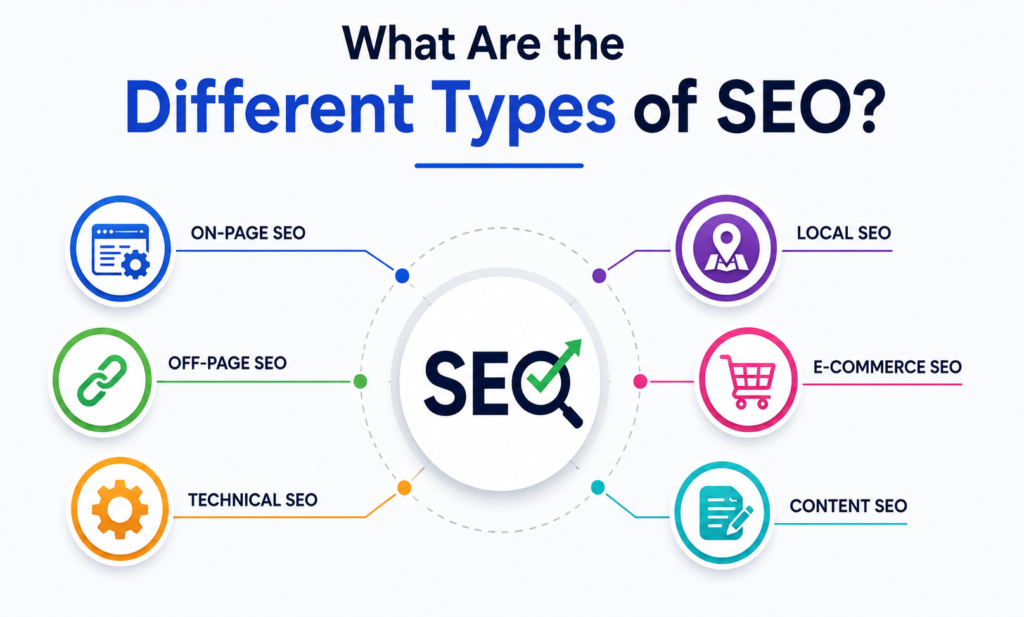
3. What Are the Different Types of SEO?
There are three main types of SEO: On-Page SEO, Off-Page SEO, and Technical SEO. On-Page SEO improves website content, Off-Page SEO builds website authority through backlinks, and Technical SEO improves website performance, speed, and indexing. All three work together to improve search engine rankings and user experience.
4. How Do Search Engines Work?
Search engines work in three steps: crawling, indexing, and ranking. First, search engine bots discover webpages by crawling. Next, they store the pages in their index. Finally, they rank the most relevant pages based on content quality, keywords, user experience, and many other ranking factors.
5. What is Crawling?
Crawling is the process where search engine bots, also called crawlers or spiders, visit websites to discover new and updated webpages. They follow links, read content, and collect information. Crawling is the first step before a webpage can be indexed and appear in search engine results.
6. What is Indexing?
Indexing is the process of storing and organizing webpages in a search engine’s database after they are crawled. If a page meets Google’s quality standards, it gets indexed and becomes eligible to appear in search results. Pages that are not indexed cannot rank on Google.
7. What is Ranking?
Ranking is the position of a webpage in search engine results for a specific keyword. Google ranks pages based on factors like content quality, relevance, backlinks, page speed, user experience, and search intent. Higher rankings usually lead to more organic traffic and better visibility.
8. What is SERP?
SERP stands for Search Engine Results Page. It is the page displayed after a user searches for a keyword on Google or another search engine. A SERP can include organic results, paid ads, featured snippets, AI Overviews, images, videos, maps, and other search features.
9. What are Organic Search Results?
Organic search results are the unpaid listings that appear on a search engine results page. They rank based on content quality, relevance, user experience, and SEO efforts instead of paid advertising. Websites with good SEO can gain higher organic rankings and attract free traffic from search engines.
10. What are Keywords?
Keywords are the words or phrases that users type into search engines to find information, products, or services. SEO professionals use relevant keywords in website content to help search engines understand the topic and match it with users’ search queries for better rankings.
11. What is Search Intent?
Search intent is the purpose behind a user’s search query. It explains what the user wants to find, learn, buy, or compare. Understanding search intent helps create content that matches user needs, improving rankings, user satisfaction, and the chances of achieving higher organic traffic.
12. What is Keyword Density?
Keyword density is the percentage of times a keyword appears in a webpage compared to the total number of words. It helps indicate content relevance, but overusing keywords can lead to keyword stuffing. Today, natural writing is more important than maintaining a fixed keyword density.
13. What is Keyword Difficulty?
Keyword difficulty is an SEO metric that estimates how hard it is to rank for a specific keyword. High-difficulty keywords usually have strong competition, while low-difficulty keywords are easier to rank for. Beginners often target low-competition, long-tail keywords to achieve faster SEO results.
14. What is CTR (Click-Through Rate)?
CTR (Click-Through Rate) is the percentage of users who click your website after seeing it in search results. It is calculated by dividing clicks by impressions and multiplying by 100. A higher CTR usually indicates that your title and meta description attract users effectively.
15. What is Bounce Rate?
Bounce rate is the percentage of visitors who leave a website after viewing only one page without taking any action. A high bounce rate may indicate poor content, slow loading speed, or an unsatisfactory user experience, but it depends on the type and purpose of the webpage.
16. What is Keyword Research?
Keyword research is the process of finding the words and phrases people search for on Google. It helps SEO professionals understand user needs and create content that matches search intent. Choosing the right keywords increases the chances of ranking higher and attracting relevant website visitors.
17. Why is Keyword Research Important?
Keyword research helps you understand what your audience is searching for. It allows you to create relevant content, improve search rankings, attract qualified visitors, and increase conversions. Without proper keyword research, your content may not reach the right audience or perform well in search results.
18. What are Short-Tail Keywords?
Short-tail keywords are broad search terms containing one or two words. They usually have high search volume but strong competition. Ranking for these keywords is difficult, especially for new websites. Examples include “SEO,” “Shoes,” or “Digital Marketing.”
19. What are Long-Tail Keywords?
Long-tail keywords are longer, more specific search phrases with lower competition and higher conversion potential. They attract users with clear search intent and are easier to rank for. New websites often target long-tail keywords to gain organic traffic more quickly.
20. What are Informational, Navigational, Commercial, and Transactional Keywords?
These keywords represent different search intents. Informational keywords seek knowledge, navigational keywords find a specific website, commercial keywords compare products or services, and transactional keywords show buying intent. Understanding search intent helps create relevant content that matches users’ needs and improves SEO performance.
21. Which Keyword Research Tools Have You Used?
Popular keyword research tools include Google Keyword Planner, Google Trends, Ahrefs, Semrush, Ubersuggest, and KeywordTool.io. These tools help identify search volume, keyword difficulty, competition, and related keywords. Google Search Console also provides valuable keyword performance data for existing websites.
22. How Do You Choose the Right Keyword?
I choose keywords based on search intent, relevance, search volume, keyword difficulty, and business goals. I also analyze competitors and prefer keywords that my website can realistically rank for. Long-tail keywords are often better for beginners because they have lower competition and higher conversion potential.
23. What is Search Volume?
Search volume is the average number of times a keyword is searched in a month. It helps estimate keyword popularity and potential traffic. However, high search volume does not always mean better rankings, as competition and search intent should also be considered.
24. What is On-Page SEO?
On-Page SEO is the process of optimizing individual webpages to improve their search engine rankings. It includes optimizing titles, headings, content, keywords, images, URLs, internal links, and meta descriptions. Good On-Page SEO helps search engines understand your content and improves the user experience.
25. What is a Title Tag?
A title tag is an HTML element that tells search engines and users the main topic of a webpage. It appears as the clickable blue title in search results and browser tabs. A clear, relevant, and keyword-rich title can improve both rankings and click-through rates.
26. What is a Meta Description?
A meta description is a short summary of a webpage displayed below the title in search results. It helps users understand the page content and encourages them to click. Although it is not a direct ranking factor, a compelling meta description can improve click-through rates.
27. What are Heading Tags?
Heading tags (H1 to H6) organize webpage content into a clear structure. The H1 tag represents the main heading, while H2, H3, and others divide content into sections. Proper heading tags improve readability, user experience, and help search engines understand your content better.
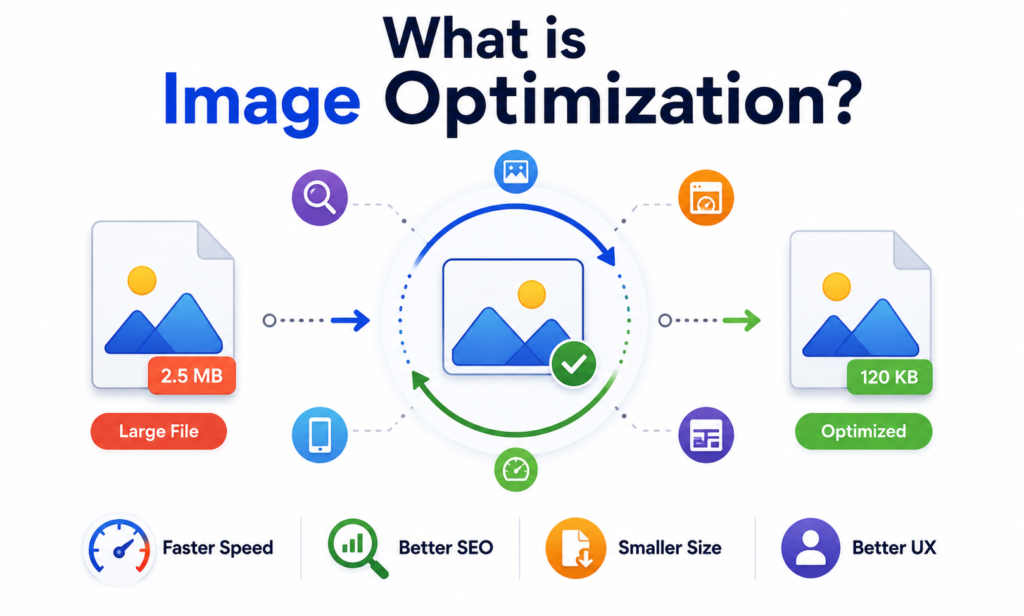
28. What is Image Optimization?
Image optimization improves website performance by reducing image size, using descriptive file names, adding alt text, and selecting the right image format. Optimized images load faster, improve user experience, and can rank in Google Images, bringing additional traffic to your website.
29. What is Image Alt Text?
Image alt text is a short description added to an image’s HTML code. It helps search engines understand the image and improves accessibility for visually impaired users. If an image does not load, the alt text is displayed instead of the image.
30. What are SEO-Friendly URLs?
SEO-friendly URLs are short, descriptive, and easy to read for both users and search engines. They include relevant keywords, avoid unnecessary numbers or symbols, and clearly describe the page topic. Clean URLs improve user experience and help search engines understand the webpage content.
31. What is Internal Linking?
Internal linking is the process of linking one page of a website to another page on the same website. It helps users navigate easily, improves website structure, distributes page authority, and helps search engines discover and index important pages more efficiently.
32. What is a Canonical Tag?
A canonical tag is an HTML tag that tells search engines which version of a webpage is the original when duplicate or similar pages exist. It helps avoid duplicate content issues and ensures the preferred page receives the ranking signals.
33. How Do You Optimize a Webpage for SEO?
To optimize a webpage, perform keyword research, write high-quality content, optimize the title tag and meta description, use proper heading tags, add internal links, optimize images, improve page speed, make the page mobile-friendly, and ensure the content matches the user’s search intent.
34. What is Technical SEO?
Technical SEO is the process of improving a website’s technical aspects so search engines can crawl, index, and rank it effectively. It includes page speed, mobile-friendliness, XML sitemaps, HTTPS, robots.txt, structured data, and fixing technical issues that affect website performance.
35. What is robots.txt?
A robots.txt file is a text file that tells search engine bots which pages or folders they can or cannot crawl on a website. It helps manage crawling but does not prevent pages from appearing in search results if they are indexed elsewhere.
36. What is an XML Sitemap?
An XML sitemap is a file that lists all the important pages of a website. It helps search engines discover, crawl, and index webpages more efficiently, especially new or updated pages. It can be submitted through Google Search Console for better indexing.
37. What are Core Web Vitals?
Core Web Vitals are Google’s user experience metrics that measure website performance. They include Largest Contentful Paint (LCP) for loading speed, Interaction to Next Paint (INP) for responsiveness, and Cumulative Layout Shift (CLS) for visual stability. Good scores improve user experience and support SEO.
38. What is Mobile-First Indexing?
Mobile-first indexing means Google mainly uses the mobile version of a website for crawling, indexing, and ranking. A responsive, fast, and mobile-friendly website is essential because most users browse the internet using smartphones.
39. What is Page Speed Optimization?
Page speed optimization is the process of making a website load faster by compressing images, reducing CSS and JavaScript files, enabling browser caching, using a CDN, and improving server performance. Faster websites provide a better user experience and can improve search engine rankings.
40. What is a 301 Redirect?
A 301 redirect is a permanent redirect that automatically sends users and search engines from one URL to another. It transfers most of the SEO value from the old page to the new page and is commonly used during website migrations or URL changes.
41. What is a 302 Redirect?
A 302 redirect is a temporary redirect that sends users and search engines from one URL to another for a short period. Unlike a 301 redirect, it does not permanently transfer SEO value because the original page is expected to return.
42. What is a 404 Error?
A 404 error occurs when a webpage cannot be found on the server. It usually happens when a page is deleted, moved, or the URL is incorrect. Too many 404 errors can affect user experience, so they should be fixed or redirected.
43. What is Schema Markup?
Schema markup is structured data added to a webpage that helps search engines understand its content better. It can improve search results by displaying rich snippets such as ratings, FAQs, reviews, recipes, events, and product information.
44. What is Off-Page SEO?
Off-Page SEO includes all activities performed outside a website to improve its authority and rankings. It mainly involves building high-quality backlinks, brand mentions, guest posting, digital PR, and social media promotion to increase trust and online visibility.
45. What are Backlinks?
Backlinks are links from one website to another. They act as votes of confidence, showing search engines that your content is valuable and trustworthy. High-quality backlinks from relevant websites can improve search rankings and website authority.
46. What is the Difference Between Dofollow and Nofollow Links?
Dofollow links pass SEO value, also called link equity, from one website to another and can help improve rankings. Nofollow links include a special attribute that tells search engines not to pass ranking value, although they can still drive referral traffic.
47. What is Anchor Text?
Anchor text is the clickable text used in a hyperlink. It helps users and search engines understand the topic of the linked page. Using clear, relevant, and descriptive anchor text improves user experience and supports better SEO.
48. What is Guest Posting?
Guest posting is the process of writing and publishing articles on another website within your industry. It helps build brand awareness, earn quality backlinks, reach a wider audience, and improve website authority when done on trusted and relevant websites.
49. What is Link Building?
Link building is the process of earning backlinks from other websites to improve your website’s authority and search rankings. Effective link building focuses on creating valuable content and gaining links naturally from relevant, trustworthy websites.
50. What is Domain Authority (DA)?
Domain Authority (DA) is a score developed by Moz that predicts how likely a website is to rank in search engines. The score ranges from 1 to 100. Higher DA generally indicates a stronger website, but it is a third-party metric and not a Google ranking factor.
51. How Do You Identify a Quality Backlink?
A quality backlink comes from a trusted, relevant, and authoritative website. It should be placed naturally within useful content, have relevant anchor text, and come from a website with genuine traffic. Quality backlinks improve website authority and help increase search engine rankings.
52. What is Google Search Console?
Google Search Console is a free tool from Google that helps website owners monitor and improve their website’s performance in search results. It provides data about clicks, impressions, indexing, sitemap submission, Core Web Vitals, and technical issues affecting SEO.
53. What is Google Analytics 4 (GA4)?
Google Analytics 4 (GA4) is a web analytics tool that tracks website and app user behavior. It provides insights into traffic sources, user engagement, events, conversions, and audience behavior, helping businesses measure the success of their digital marketing and SEO efforts.
54. How Do You Measure SEO Performance?
SEO performance is measured using metrics such as organic traffic, keyword rankings, click-through rate (CTR), impressions, conversions, bounce rate, engagement time, backlinks, and indexed pages. Tools like Google Search Console and GA4 help monitor these SEO performance indicators.
55. Which SEO Metrics Are Most Important?
Important SEO metrics include organic traffic, keyword rankings, click-through rate (CTR), impressions, conversions, bounce rate, engagement rate, page speed, Core Web Vitals, backlinks, and indexed pages. These metrics help evaluate website performance and identify areas for improvement.
56. Which SEO Tools Have You Used?
Common SEO tools include Google Search Console, Google Analytics 4, Google Keyword Planner, Google Trends, Ahrefs, Semrush, Screaming Frog, PageSpeed Insights, GTmetrix, Rank Math, Yoast SEO, and ChatGPT. These tools help with keyword research, website audits, tracking, and optimization.
57. What is Google Tag Manager (GTM)?
Google Tag Manager is a free tool that allows marketers to add and manage tracking codes, such as Google Analytics and Meta Pixel, without editing website code. It makes tracking user actions easier and improves website tag management.
58. What is Google PageSpeed Insights?
Google PageSpeed Insights is a free tool that analyzes a webpage’s loading speed and user experience. It provides performance scores and recommendations to improve Core Web Vitals, page speed, accessibility, SEO, and overall website performance.
59. How is AI Changing SEO?
AI is changing SEO by improving search results, understanding user intent, and generating smarter answers. SEO professionals now use AI tools for keyword research, content creation, technical audits, and optimization. Human creativity and high-quality content remain essential for long-term SEO success.
AI is transforming every aspect of digital marketing. If you’d like to understand how autonomous AI systems are changing SEO, content marketing, and campaign optimization, read our detailed guide on Agentic AI in Marketing.
60. What is Google AI Overview?
Google AI Overview is an AI-powered search feature that provides summarized answers at the top of search results. It gathers information from multiple trusted sources, helping users find quick answers without visiting several websites.
61. What is Generative Engine Optimization (GEO)?
Generative Engine Optimization (GEO) is the process of creating content that can be easily understood and used by AI-powered search engines and chatbots. It focuses on clear answers, structured content, credibility, and helpful information for AI-generated search results.
62. What is Answer Engine Optimization (AEO)?
Answer Engine Optimization (AEO) is the practice of creating content that directly answers user questions. It helps websites appear in featured snippets, voice search, AI-generated answers, and other answer-based search experiences by providing clear and accurate information.
63. What is Entity SEO?
Entity SEO focuses on optimizing content around people, places, organizations, products, and concepts instead of only keywords. It helps search engines better understand relationships between topics, improving content relevance and visibility in modern search results.
64. What is Topical Authority?
Topical authority means becoming a trusted source on a specific subject by publishing high-quality, detailed, and interconnected content. Websites with strong topical authority are more likely to rank higher because search engines recognize their expertise in that topic.
65. What is Semantic SEO?
Semantic SEO is the practice of creating content that covers a topic naturally using related keywords, entities, and user intent instead of repeating the same keyword. It helps search engines understand the complete meaning and context of the content.
66. Which AI Tools Do You Use for SEO?
Popular AI tools for SEO include ChatGPT, Google Gemini, Claude, Perplexity AI, Surfer SEO, Frase, Jasper AI, and Grammarly. These tools help with content ideas, keyword research, technical SEO, content optimization, and improving writing quality.
67. How Do You Optimize Content for ChatGPT, Gemini, and Perplexity?
Create accurate, well-structured, and easy-to-understand content with clear headings, simple language, trusted sources, and direct answers. Focus on user intent, topical authority, and high-quality information so AI platforms can understand and recommend your content.
68. What Are the Latest Google SEO Updates in 2026?
The latest SEO trends in 2026 include Google AI Overview, AI-powered search, Helpful Content, E-E-A-T, Entity SEO, Semantic SEO, Core Web Vitals, Topical Authority, Voice Search, Zero-Click Search, and high-quality human-focused content. SEO professionals should stay updated with Google’s latest guidelines and algorithm changes.
Conclusion
SEO continues to be one of the fastest-growing career options in digital marketing. Companies are looking for freshers who understand SEO fundamentals, have practical knowledge, and stay updated with the latest Google Search and AI trends.
Preparing for interviews is not about memorizing definitions. It is about understanding how SEO works in real-world situations, using tools like Google Search Console and GA4, and solving problems with confidence.
SEO interviews are often part of a broader digital marketing hiring process. After completing this guide, don’t forget to practice our Digital Marketing Interview Questions for Freshers to prepare for questions related to Google Ads, Meta Ads, email marketing, analytics, and content marketing.
The future of SEO includes AI-powered search, semantic SEO, entity optimization, topical authority, and user-focused content. By learning these concepts and practicing regularly, you can stand out from other candidates and increase your chances of getting hired.
After preparing these SEO Interview Questions for Freshers, don’t forget to practice our Digital Marketing Interview Questions for Freshers to improve your chances of getting hired.
Before attending your interview, revise these SEO Interview Questions for Freshers, practice every answer aloud, build a small SEO portfolio, and stay updated with Google Search. These SEO Marketing Interview Questions for Freshers will help you build confidence and improve your chances of getting your first SEO job.
Reviewing these Interview Questions and Answer for SEO regularly, practicing on live websites, and understanding the latest Google Search updates will help you answer interview questions with confidence. If you’re targeting competitive companies, you should also prepare Advanced SEO Interview Questions and Answer for Fresher candidates covering Technical SEO, AI SEO, and Google Search Console.
Before attending your interview, review all 60+ SEO Interview Questions for Freshers, practice your answers aloud, work on live SEO projects, and keep learning from Google’s latest updates. Continuous learning, practical experience, and confidence are the keys to building a successful career in SEO.
Frequently Asked Questions (FAQs)
How do I prepare for an SEO interview?
The best way to prepare is by practicing SEO Interview Questions for Freshers, working on live SEO projects, using Google Search Console, and understanding how search engines work.
Can freshers crack SEO interviews?
Yes. Companies hire freshers who understand SEO basics, have practical experience, and show a willingness to learn. A small portfolio or personal website can improve your chances.
What are the latest SEO Interview Questions for Freshers in 2026?
The latest SEO Interview Questions for Freshers include keyword research, Technical SEO, Core Web Vitals, Google Search Console, AI SEO, Entity SEO, Answer Engine Optimization (AEO), and Advanced SEO Interview Questions and Answer for Fresher candidates related to modern search technologies.
Which SEO tools should I know?
You should know Google Search Console, GA4, Google Keyword Planner, Google Trends, Ahrefs, Semrush, Screaming Frog, PageSpeed Insights, and basic AI tools like ChatGPT and Gemini.
Do companies ask practical SEO questions?
Yes. Recruiters often ask how you would improve rankings, fix indexing issues, perform keyword research, or optimize a webpage for better performance.
How important is Google Search Console?
It is one of the most important SEO tools because it helps monitor website performance, indexing, technical issues, and search traffic directly from Google.
Should I learn Google Analytics 4?
Yes. GA4 helps you understand website traffic, user behavior, conversions, and campaign performance, making it an essential skill for SEO professionals.
What AI tools should I learn for SEO?
ChatGPT, Google Gemini, Claude, Perplexity AI, Surfer SEO, and Frase are useful tools for keyword research, content planning, SEO analysis, and optimization.
Do I need an SEO certification?
A certification is helpful but not mandatory. Practical skills, live projects, and knowledge of SEO tools often matter more during interviews.
How long should I prepare for an SEO interview?
Most beginners can prepare in 4–8 weeks by learning SEO concepts, practicing on a website, and using Google SEO tools regularly.
What projects should I include in my portfolio?
Include keyword research reports, website audits, optimized blog posts, technical SEO improvements, and Google Search Console performance reports.
How do I explain SEO in an interview?
Explain that SEO is the process of improving a website to increase its visibility in organic search results and attract relevant visitors through quality content and technical optimization.
What should I ask HR after an SEO interview?
You can ask about training opportunities, team structure, SEO tools used by the company, career growth, and the onboarding process.
Can I get an SEO job without experience?
Yes. Many companies hire SEO trainees and interns. Practical knowledge, certifications, and personal SEO projects can help you secure your first job.
What is the best way to learn SEO?
The best way is to combine theory with practice. Create your own website, optimize content, use Google Search Console and GA4, follow Google’s official documentation, and stay updated with the latest SEO trends.