Digital marketing has become one of the most exciting and rewarding career choices for students, graduates, and professionals looking to build a future in the online world. Every year, thousands of companies hire freshers for digital marketing roles, creating countless opportunities across startups, agencies, eCommerce brands, and multinational organizations. However, getting your dream job requires more than completing a course—you must also perform well in the interview.
If you are searching for the most practical Digital Marketing Interview Questions, you’re in the right place.
This comprehensive guide has been created by industry experts to help beginners understand what interviewers actually expect in 2026. Instead of simply memorizing definitions, you’ll learn how to answer confidently, explain your thought process, and demonstrate your practical understanding during interviews.
Today, companies are hiring candidates who can think creatively, solve marketing challenges, work with AI tools, and communicate effectively.
If you’re just beginning your journey, enrolling in a Digital Marketing Course in Ahmedabad can help you build practical skills through live projects, industry tools, and placement-focused training. Before choosing any program, it’s also worth reading 7 Things to Know Before Starting Digital Marketing Learning in 2026 so you understand the latest industry expectations and career opportunities.
Whether you’re applying for an internship, your first job, or switching careers, preparing with the right Digital Marketing Interview Questions and Answers can significantly improve your confidence.
Throughout this guide, you’ll discover real interview scenarios, expert explanations, HR insights, practical examples, and professional tips that help you stand out from other candidates.
By the end of this article, you’ll not only know the right answers but also understand why interviewers ask each Digital Marketing Question for Interview and how you can answer naturally without sounding rehearsed.
Let’s begin your interview preparation journey.
Why Digital Marketing Interviews Are Important
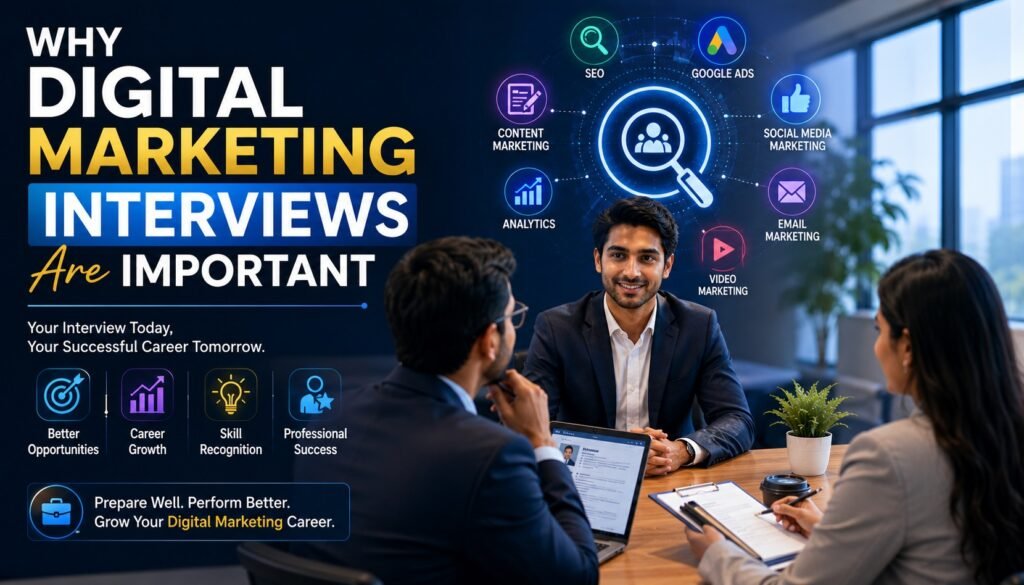
Landing a digital marketing job is no longer just about having a certificate. Employers want candidates who can think strategically, adapt quickly, and understand how digital channels help businesses grow. That’s why preparing with relevant Interview Questions About Digital Marketing is essential for every fresher.
The Demand for Digital Marketers Is Growing
Businesses of every size now rely on digital platforms to attract customers, generate leads, and increase sales. As more consumers spend time online, companies need skilled digital marketers to build brand awareness, manage campaigns, and improve customer engagement.
This demand has created opportunities across industries, including healthcare, education, finance, retail, travel, manufacturing, and technology.
Popular Career Opportunities
- Digital Marketing Executive
- Marketing Intern
- Social Media Executive
- SEO Executive
- Content Marketing Associate
- Email Marketing Executive
- Performance Marketing Executive
- Marketing Coordinator
- Brand Executive
- Digital Marketing Analyst
Even if you’re starting as a fresher, these roles offer strong career growth with continuous learning opportunities.
Opportunities in Startups
Startups often look for enthusiastic candidates who are willing to learn quickly and take ownership of multiple marketing tasks.
As a fresher, you may get exposure to:
- Social media campaigns
- Website updates
- Email marketing
- AI-powered content creation
- Customer research
- Lead generation
- Marketing reports
Working in a startup helps you develop practical skills much faster.
Agency Experience Builds Versatility
Digital marketing agencies work with clients from different industries. This allows freshers to experience multiple business models and marketing strategies within a short period.
Agency interviews often include scenario-based Digital Marketing Interview Questions because employers want to understand how you think and solve problems.
Corporate Companies Need Marketing Professionals
Large organizations hire digital marketers to manage brand communication, customer acquisition, analytics, and online advertising.
Corporate recruiters generally assess:
- Communication skills
- Problem-solving ability
- Marketing awareness
- Team collaboration
- Adaptability
- AI knowledge
- Analytical thinking
Your technical knowledge is important, but your attitude often matters just as much.
Freelancing Is Becoming a Popular Career Option
Digital marketing also offers excellent freelancing opportunities. Many professionals begin their careers with full-time jobs and later start offering services independently.
If you understand digital marketing fundamentals and can showcase practical work, freelancing becomes an additional career option.
AI Is Changing the Hiring Process
Artificial Intelligence is transforming recruitment across industries.
Today, companies use AI to:
- Screen resumes
- Evaluate skills
- Schedule interviews
- Conduct initial assessments
- Analyze candidate responses
This means recruiters are increasingly looking for candidates who are comfortable using AI tools while understanding when human creativity and decision-making are essential.
Learning tools like ChatGPT, Gemini, Claude, Canva AI, Notion AI, and Microsoft Copilot can give you a competitive advantage during interviews.
Students who complete a practical Digital Marketing Course or participate in live internship projects often perform better during interviews because they can confidently discuss real campaign experiences instead of only theoretical concepts.
Quick Summary
- Digital marketing jobs are growing rapidly.
- Practical knowledge is valued more than certificates.
- AI skills are becoming increasingly important.
- Strong communication helps you stand out.
- Interview preparation increases your confidence and improves your chances of getting hired.
Top 51 Digital Marketing Interview Questions and Answers (Updated 2026)
1. What is Digital Marketing?
Answer
Digital marketing is the process of promoting products or services using online channels like Google, social media, websites, email, and mobile apps. It helps businesses reach the right audience, generate leads, increase sales, and build brand awareness. Unlike traditional marketing, digital marketing provides real-time data, making it easier to measure and improve campaign performance.
Quick Interview Tip: Explain that digital marketing helps businesses grow online by reaching the right customers at the right time.
2. Why is Digital Marketing Important?
Answer
Digital marketing is important because most customers search for products and services online before making a purchase. It helps businesses reach a larger audience, target the right customers, increase website traffic, generate leads, and improve sales. It is also more affordable and measurable than traditional marketing, making it suitable for businesses of all sizes.
Quick Interview Tip: Focus on business growth, customer reach, and measurable results.
3. What Are the Different Types of Digital Marketing?
Answer
Digital marketing includes several channels that work together to promote a business. The main types are:
- Search Engine Optimization (SEO)
- Social Media Marketing (SMM)
- Google Ads (PPC)
- Content Marketing
- Email Marketing
- Affiliate Marketing
- Influencer Marketing
- Video Marketing
- Mobile Marketing
Each channel serves a different purpose, but together they help businesses attract, engage, and convert customers.
Quick Interview Tip: Mention at least five major types confidently.
4. What is the digital marketing funnel?
Answer
A Digital Marketing Funnel explains the journey a customer takes before buying a product or service. The main stages are:
- Awareness
- Interest
- Consideration
- Conversion
- Retention
Businesses create different marketing strategies for each stage to guide customers from discovering a brand to becoming loyal customers.
Quick Interview Tip: Explain the funnel using a simple customer buying journey.
5. What is a Buyer Persona?
Answer
A Buyer Persona is a detailed profile of an ideal customer based on research and data. It includes information like age, occupation, interests, goals, challenges, location, and buying behavior. Businesses use buyer personas to create better content, advertisements, and marketing campaigns that connect with the right audience.
Quick Interview Tip: Say that a buyer persona helps businesses understand their ideal customer.
6. What is a Target Audience?
Answer
A Target Audience is the specific group of people a business wants to reach through its marketing campaigns. Businesses identify their target audience based on age, gender, location, interests, income, profession, and online behavior. Understanding the target audience helps create more relevant content and improve marketing results.
Quick Interview Tip: Explain that marketing becomes more effective when businesses target the right audience instead of everyone.
7. What are KPIs in Digital Marketing?
Answer
KPIs (Key Performance Indicators) are measurable values used to evaluate the success of a digital marketing campaign. Common KPIs include website traffic, conversion rate, click-through rate (CTR), cost per lead (CPL), return on investment (ROI), engagement rate, and sales. Businesses choose KPIs based on their campaign goals.
Quick Interview Tip: Mention that different campaigns have different KPIs.
8. How Do You Measure the Success of a Digital Marketing Campaign?
Answer
The success of a digital marketing campaign is measured by comparing its results with predefined goals. Marketers track metrics like website traffic, leads, conversions, sales, ROI, engagement, and click-through rate. A successful campaign is one that achieves business objectives while delivering a good return on investment.
Quick Interview Tip: Always connect campaign success with business goals, not just likes or followers.
9. What is Lead Generation?
Answer
Lead generation is the process of attracting people who are interested in a business and collecting their contact details. Businesses generate leads using websites, landing pages, Google Ads, social media, email marketing, and valuable content. The goal is to convert interested visitors into paying customers.
Quick Interview Tip: Explain that quality leads are more valuable than a large number of unqualified leads.
10. What is Conversion in Digital Marketing?
Answer
A conversion happens when a visitor completes a desired action on a website or landing page. This action can be making a purchase, filling out a form, downloading an eBook, signing up for a newsletter, or booking a consultation. Every business defines conversions based on its marketing objectives.
Quick Interview Tip: Remember that conversions are not limited to sales; any valuable customer action can be a conversion.
11. What is a Landing Page?
Answer
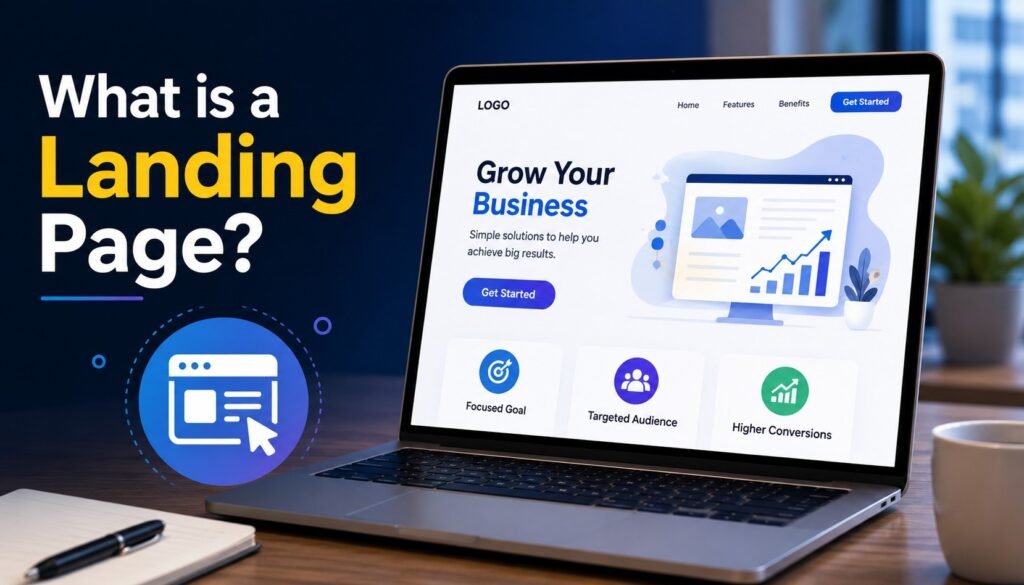
A Landing Page is a web page designed for one specific goal, such as collecting leads, selling a product, or getting registrations. Unlike a homepage, it focuses on a single Call-to-Action (CTA) and removes unnecessary distractions. A good landing page improves conversion rates and helps businesses achieve better marketing results.
Quick Interview Tip: Say that a landing page is created to encourage visitors to take one specific action.
12. What is a Call-to-Action (CTA)?
Answer
A Call-to-Action (CTA) is a button, link, or message that encourages users to take the next step. Common CTAs include Buy Now, Contact Us, Download Now, Register Today, and Get Started. A strong CTA guides users toward completing a desired action and improves conversions.
Quick Interview Tip: Explain that every marketing campaign should have a clear CTA.
13. What is ROI in Digital Marketing?
Answer
ROI (Return on Investment) measures how much profit a business earns compared to the money spent on marketing. It helps marketers understand whether a campaign is successful or needs improvement. A positive ROI means the campaign generated more revenue than it cost.
Quick Interview Tip: Mention that businesses use ROI to make smarter marketing decisions.
14. What is Marketing Automation?
Answer
Marketing Automation is the use of software and AI tools to automate repetitive marketing tasks like sending emails, scheduling social media posts, nurturing leads, and following up with customers. It saves time, improves efficiency, and delivers personalized customer experiences.
Quick Interview Tip: Explain that automation supports marketers but does not replace human creativity.
15. What are the Latest Digital Marketing Trends?
Answer
Some of the latest digital marketing trends in 2026 include AI-powered marketing, short-form videos, voice search optimization, personalized marketing, influencer collaborations, marketing automation, first-party data, and interactive content. Businesses that follow these trends stay competitive and improve customer engagement.
Quick Interview Tip: Mention AI and personalization because they are among the biggest marketing trends today.
16. What AI Tools Have You Used?
Answer
Some popular AI tools used in digital marketing are ChatGPT, Google Gemini, Claude AI, Canva AI, Grammarly AI, Microsoft Copilot, Notion AI, and Perplexity AI. These tools help with content creation, research, design, brainstorming, and productivity. However, marketers should always review AI-generated content before publishing it.
If you want to understand how AI is evolving beyond content generation, explore Agentic AI in Marketing to learn how AI agents are helping marketers automate research, campaign optimization, customer interactions, and decision-making.
Quick Interview Tip: Explain how AI helps you work faster while human creativity ensures quality.
17. Why Should We Hire You?
Answer
You should hire me because I have a strong interest in digital marketing, a willingness to learn, and practical knowledge gained through projects and training. I am a quick learner, adaptable to new technologies, and ready to contribute to the company’s growth. I believe my positive attitude and dedication make me a valuable team member.
Quick Interview Tip: Focus on your learning attitude, practical skills, and enthusiasm instead of saying you know everything.
18. Tell Me About Yourself.
Answer
My name is ________. I recently completed my graduation and digital marketing training. During my learning journey, I gained knowledge of SEO, social media marketing, Google Ads, content marketing, email marketing, and AI tools. I enjoy learning new skills, solving problems, and staying updated with the latest digital marketing trends. I am looking for an opportunity to apply my knowledge, gain real-world experience, and grow as a digital marketing professional.
Quick Interview Tip: Keep your introduction within 1–2 minutes and focus on your education, skills, and career goals.
19. What Are Your Strengths and Weaknesses?
Answer
My strengths are quick learning, adaptability, communication skills, and problem-solving. I enjoy learning new marketing strategies and AI tools. One of my weaknesses is that I sometimes spend extra time perfecting my work, but I am improving my time management by setting priorities and deadlines.
Quick Interview Tip: Be honest about your weakness and explain how you are improving it.
20. How Do You Stay Updated with Digital Marketing?
Answer
I stay updated by reading digital marketing blogs, following industry experts on LinkedIn, watching educational YouTube videos, attending webinars, and practicing with AI tools. I also follow Google updates and explore new marketing trends regularly to improve my knowledge and skills.
Quick Interview Tip: Show that learning is a continuous process and mention at least two trusted learning sources.
21. Where Do You See Yourself in Five Years?
Answer
In the next five years, I want to become a skilled digital marketing professional who can manage campaigns, analyze performance, and help businesses grow online. I also want to improve my leadership skills, learn advanced marketing strategies, and stay updated with AI and new digital marketing trends. My goal is to continuously learn and take on more responsibilities.
Quick Interview Tip: Show your willingness to learn and grow with the company.
22. Why Did You Choose Digital Marketing as a Career?
Answer
I chose digital marketing because it is a fast-growing industry with excellent career opportunities. It combines creativity, technology, data analysis, and communication. I enjoy learning how businesses attract customers online and use different marketing strategies to grow. Since digital marketing is always evolving, it offers continuous learning and career growth.
Quick Interview Tip: Share your genuine interest instead of giving a memorized answer.
23. Describe a Digital Marketing Campaign That Impressed You.
Answer
One campaign that impressed me focused on storytelling instead of direct selling. The brand created useful and engaging content that connected with customers emotionally. It used social media, videos, and customer stories to build trust. This campaign showed me that understanding the audience is more important than simply promoting products.
Quick Interview Tip: Choose a well-known campaign and explain why it was successful.
24. How Would You Handle a Challenging Marketing Project as a Fresher?
Answer
I would first understand the project requirements and business goals. Then I would research the target audience, study competitors, create a simple strategy, and ask my senior or mentor for guidance if needed. I believe teamwork, continuous learning, and problem-solving are the best ways to handle new challenges.
Quick Interview Tip: Show confidence and explain your step-by-step approach.
SEO Interview Questions 2026
25. What is SEO?
Answer
SEO (Search Engine Optimization) is the process of improving a website so it appears higher in Google search results. The main goal of SEO is to increase organic (free) traffic by creating helpful content, improving website quality, and providing a better user experience. Good SEO helps businesses attract more visitors without paying for ads.
Quick Interview Tip: Remember that SEO is about helping users, not just search engines.
26. What is the Difference Between On-Page SEO and Off-Page SEO?
Answer
On-Page SEO includes all the optimizations done on a website, such as improving content, headings, keywords, images, and internal links.
Off-Page SEO includes activities outside the website, such as building backlinks, brand mentions, guest posting, and digital PR to improve website authority.
Both are important for improving search rankings.
Quick Interview Tip: Simply remember: On-Page = Inside Website | Off-Page = Outside Website.
27. What is Keyword Research and Why is it Important?
Answer
Keyword research is the process of finding the words and phrases people search for on Google. It helps businesses understand customer needs and create relevant content. Good keyword research improves SEO, increases website traffic, and helps attract the right audience.
Quick Interview Tip: Explain that keyword research is about understanding user intent, not just finding popular keywords.
28. What are Backlinks?
Answer
Backlinks are links from one website to another. They help search engines understand that your website is trustworthy and valuable. High-quality backlinks from reputable websites can improve search rankings, increase website authority, and drive referral traffic.
Quick Interview Tip: Mention that quality backlinks are more valuable than a large number of low-quality links.
29. What is Technical SEO?
Answer
Technical SEO focuses on improving the technical performance of a website so search engines can crawl and index it easily. It includes website speed, mobile-friendliness, HTTPS security, XML sitemaps, structured data, fixing broken links, and improving Core Web Vitals.
Quick Interview Tip: Explain that Technical SEO improves both search engine crawling and user experience.
Social Media Marketing Interview Questions in 2026
30. What is Social Media Marketing?
Answer
Social Media Marketing (SMM) is the process of promoting a business through platforms like Facebook, Instagram, LinkedIn, YouTube, and X (Twitter). Businesses use social media to build brand awareness, engage with customers, generate leads, and increase sales by sharing valuable and engaging content.
Quick Interview Tip: Focus on customer engagement and brand building, not just posting content.
31. Which Social Media Platforms Are Best for Businesses?
Answer
The best social media platform depends on the business and its target audience. Facebook is great for local businesses, Instagram is ideal for fashion and lifestyle brands, LinkedIn works well for B2B companies, YouTube is best for educational and video content, and Pinterest is useful for home décor and fashion brands. Businesses should choose platforms where their customers are most active.
Quick Interview Tip: Don’t say one platform is best for every business. It depends on the audience.
32. How Do You Increase Engagement on Social Media?
Answer
To increase engagement, businesses should post valuable content, use high-quality images and videos, ask questions, reply to comments, run polls, use trending hashtags, and post consistently. Understanding the target audience and sharing useful content helps build trust and improve engagement.
Quick Interview Tip: Engagement is about building relationships, not just getting likes.
33. What is Organic Reach?
Answer
Organic reach is the number of people who see your social media posts without using paid advertisements. It depends on content quality, audience engagement, posting consistency, and social media algorithms. High-quality and engaging content usually reaches more people organically.
Quick Interview Tip: Organic reach means free visibility, while paid reach comes from advertisements.
34. How Do You Measure the Success of a Social Media Campaign?
Answer
The success of a social media campaign is measured using metrics like reach, impressions, engagement rate, website traffic, leads, conversions, click-through rate (CTR), and Return on Investment (ROI). The right metric depends on the campaign goal.
Quick Interview Tip: Always relate campaign success to business objectives.
Google Ads Interview Questions in 2026
35. What is Google Ads?
Answer
Google Ads is Google’s online advertising platform that helps businesses promote their products and services on Google Search, YouTube, Gmail, Google Maps, and partner websites. It helps businesses increase website traffic, generate leads, and boost sales through targeted advertising.
Quick Interview Tip: Mention that Google Ads helps businesses reach people who are actively searching for products or services.
36. What is PPC?
Answer
PPC (Pay-Per-Click) is an online advertising model where advertisers pay only when someone clicks on their advertisement. It is commonly used in Google Ads and social media advertising. PPC helps businesses get immediate traffic and measurable results.
Quick Interview Tip: Remember: No Click = No Payment.
37. What is Quality Score?
Answer
Quality Score is Google’s rating of the quality and relevance of your keywords, ads, and landing pages. A higher Quality Score can improve ad rankings and reduce advertising costs. Google considers factors like expected click-through rate (CTR), ad relevance, and landing page experience.
Quick Interview Tip: Better relevance usually means a better Quality Score.
38. What is the Difference Between Search Ads and Display Ads?
Answer
Search Ads appear on Google Search when users search for specific keywords. They target people with high buying intent.
Display Ads appear on websites, apps, and YouTube. They use images or banners to build brand awareness and reach a wider audience.
Quick Interview Tip: Search Ads capture demand, while Display Ads create demand.
39. Which Bidding Strategies Are Available in Google Ads?
Answer
Google Ads offers different bidding strategies based on campaign goals. Some common strategies are:
- Manual CPC
- Maximize Clicks
- Maximize Conversions
- Target CPA
- Target ROAS
- Maximize Conversion Value
- Target Impression Share
Businesses choose a bidding strategy based on whether they want more traffic, leads, sales, or brand awareness.
Quick Interview Tip: Mention that Smart Bidding uses AI to optimize bids automatically.
Content Marketing Interview Questions in 2026
40. What is Content Marketing?
Answer
Content Marketing is the process of creating and sharing valuable content to attract, educate, and engage potential customers. It includes blogs, videos, social media posts, infographics, podcasts, eBooks, and newsletters. Good content builds trust, improves SEO, generates leads, and supports business growth.
Quick Interview Tip: Content Marketing is about providing value first and selling later.
41. Why is Content Marketing Important?
Answer
Content Marketing is important because it helps businesses educate customers, build trust, improve SEO, generate leads, and increase sales. High-quality content answers customer questions and helps people make better buying decisions. It also improves brand awareness and creates long-term relationships with customers.
Quick Interview Tip: Explain that good content solves customer problems, not just promotes products.
42. What Makes Good Content?
Answer
Good content is helpful, original, easy to understand, and relevant to the target audience. It should answer user questions, provide useful information, and include a clear call-to-action (CTA). High-quality content is well-structured, engaging, and optimized for both users and search engines.
Quick Interview Tip: Focus on creating content for people first, then optimize it for search engines.
43. What is a Content Strategy?
Answer
A Content Strategy is a plan for creating, publishing, and managing content to achieve business goals. It includes identifying the target audience, selecting content topics, choosing the right platforms, creating a content calendar, and measuring performance. A good strategy helps businesses publish consistent and valuable content.
Quick Interview Tip: Remember that content without a strategy rarely delivers good results.
44. How Do You Measure Content Performance?
Answer
Content performance is measured using metrics like website traffic, page views, time on page, bounce rate, social shares, engagement, leads, conversions, and search engine rankings. These metrics help marketers understand what content performs well and what needs improvement.
Quick Interview Tip: Connect content performance with business goals, not just page views.
Email Marketing Interview Questions in 2026
45. What is Email Marketing?
Answer
Email Marketing is the process of sending emails to customers and potential customers to build relationships, promote products, share updates, and generate sales. It is one of the most cost-effective digital marketing channels because it allows businesses to communicate directly with their audience.
Quick Interview Tip: Mention that email marketing helps build long-term customer relationships.
46. What is an Email Open Rate?
Answer
Email Open Rate is the percentage of people who open an email after receiving it. It shows how effective the email subject line and sender name are. A higher open rate usually means the email attracted the audience’s attention.
Quick Interview Tip: Open Rate measures opens, not clicks or sales.
47. What is Email Segmentation?
Answer
Email Segmentation is the process of dividing an email list into smaller groups based on factors like age, location, interests, purchase history, or customer behavior. It helps businesses send more personalized emails, which improves engagement and conversion rates.
Quick Interview Tip: Personalized emails usually perform better than generic emails.
48. What is A/B Testing in Email Marketing?
Answer
A/B Testing is a method of comparing two versions of an email to see which one performs better. Marketers test subject lines, images, CTAs, layouts, or sending times to improve open rates, click rates, and conversions.
Quick Interview Tip: Test only one element at a time for accurate results.
49. How Do You Improve Email Campaign Performance?
Answer
Email campaign performance can be improved by writing better subject lines, personalizing emails, segmenting the audience, using clear CTAs, optimizing for mobile devices, testing different email versions, and sending valuable content consistently.
Quick Interview Tip: Always review campaign data and keep improving your emails.
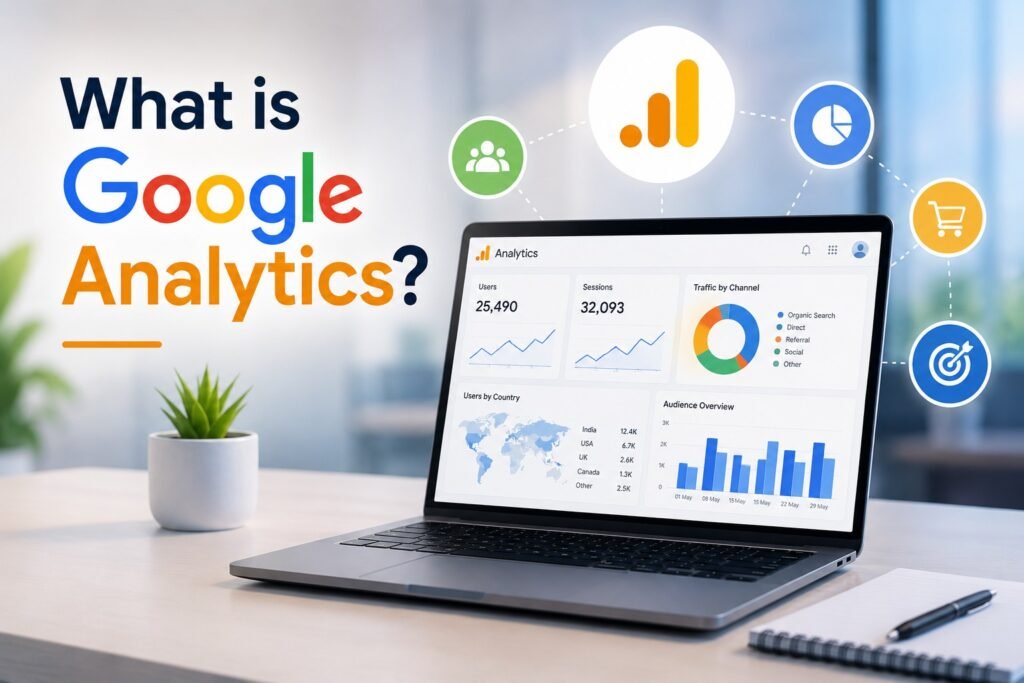
50. What is Google Analytics?
Answer
Google Analytics is a free web analytics tool that helps businesses understand how visitors interact with their website. It tracks website traffic, user behavior, traffic sources, conversions, and customer journeys. Marketers use this data to improve website performance and make better marketing decisions.
Quick Interview Tip: Say that Google Analytics helps businesses make data-driven decisions.
51. How is AI Changing Digital Marketing?
Answer
AI is changing Digital Marketing by helping businesses create content, analyze data, automate marketing tasks, personalize customer experiences, optimize advertising campaigns, and improve customer support through chatbots. AI saves time and improves productivity, but human creativity and strategic thinking are still essential.
Quick Interview Tip: Explain that AI is a tool that supports marketers—it does not replace them
Conclusion
Preparing for your first digital marketing interview may feel challenging, but with the right approach, it becomes a valuable learning experience. The most successful candidates are not those who memorize every answer—they are the ones who understand marketing concepts, think logically, communicate clearly, and demonstrate a willingness to learn.
Throughout this guide, we’ve covered the Top 51 Digital Marketing Interview Questions that freshers are most likely to face in internships, agency interviews, startup hiring, and corporate recruitment processes. From understanding digital marketing fundamentals to discussing AI, content strategy, customer behavior, and campaign measurement, each question was designed to help you build confidence and answer professionally.
Remember that recruiters are looking for more than technical knowledge. They want candidates who can solve problems, adapt to new technologies, work collaboratively, and understand how digital marketing contributes to business growth. Even if you don’t know the answer to every question, a positive attitude and logical thinking can leave a lasting impression.
Digital marketing is one of the fastest-growing career fields, and new opportunities continue to emerge every year. Whether you want to work in an agency, join a startup, build a corporate career, become a freelancer, or launch your own business, strong interview preparation is the first step toward success.
If you’re serious about building your career, consider joining a practical Digital Marketing course in Surat where you can work on live projects, build a professional portfolio, and prepare for interviews with industry experts.
As AI continues to reshape the marketing industry, professionals who combine human creativity with AI-powered productivity tools will have a significant competitive advantage. Keep learning, stay curious, and continue practicing with real-world projects.
Frequently Asked Questions (FAQs)
How do I prepare for a Digital Marketing interview?
Start by understanding the basics of digital marketing, including customer journeys, content, SEO, social media, paid advertising, email marketing, analytics, and AI. Practice common Digital Marketing Interview Questions, build a portfolio with sample projects, research the company, and conduct mock interviews to improve your confidence and communication skills.
What are the most common Digital Marketing interview questions?
Some of the most frequently asked questions include:
- What is Digital Marketing?
- Why is Digital Marketing important?
- What is SEO?
- What is lead generation?
- What is ROI?
- What is Google Ads?
- Tell me about yourself.
- Why should we hire you?
- What AI tools have you used?
- How do you stay updated with digital marketing?
These questions help interviewers assess both technical knowledge and communication skills.
Can a fresher crack a Digital Marketing interview?
Yes. Many companies actively hire freshers with strong fundamentals, practical learning, and a positive attitude. Employers understand that beginners may not have industry experience, but they expect curiosity, logical thinking, and a willingness to learn. Preparing thoroughly with Digital Marketing Interview Questions and Answers significantly improves your chances of getting selected.
What skills should I mention in a Digital Marketing interview?
Highlight both technical and soft skills, such as:
- Communication
- Content creation
- Analytical thinking
- Research
- Creativity
- Problem-solving
- Teamwork
- Adaptability
- AI literacy
- Presentation skills
Mention practical projects where you’ve applied these skills to demonstrate real-world understanding.
How important is practical knowledge in Digital Marketing?
Practical knowledge is extremely important. Recruiters prefer candidates who can apply concepts rather than simply define them. Even personal projects, internships, college assignments, or self-created campaigns can demonstrate your ability to think strategically and solve marketing problems.
What should I include in my Digital Marketing portfolio?
A beginner’s portfolio can include:
- Blog articles
- Social media creatives
- Content calendars
- SEO audits
- Keyword research samples
- Landing page designs
- Email campaign drafts
- Marketing strategies
- Google Ads campaign plans
- Certifications
A well-organized portfolio often creates a stronger impression than certificates alone.
What AI tools should I know before attending a Digital Marketing interview?
Freshers should understand commonly used AI tools such as ChatGPT, Google Gemini, Claude AI, Canva Magic Studio, Microsoft Copilot, Grammarly AI, Notion AI, and Perplexity AI. You don’t need expert-level knowledge, but you should know how these tools improve productivity while recognizing the importance of human creativity and review.
How long should I prepare for a Digital Marketing interview?
Most freshers can build a strong foundation within four to eight weeks through consistent learning and practice. Focus on understanding concepts, completing practical assignments, improving communication skills, and revising Digital Marketing Interview Questions regularly rather than trying to memorize every answer.
Is a Digital Marketing certification necessary to get a job?
A certification can strengthen your resume and demonstrate your commitment to learning, but it is not enough by itself. Employers value practical skills, projects, communication, and problem-solving abilities more than certificates. Combining certification with hands-on experience provides the best results.
What should I ask the interviewer at the end of the interview?
Asking thoughtful questions shows genuine interest in the role. You can ask about team structure, learning opportunities, success metrics, marketing tools, current challenges, or career growth within the organization. Avoid asking questions whose answers are already available on the company’s website.