
If you are planning to advertise your business on Google, one of the first questions you will probably ask is: How much does Google Ads cost?
The short answer is that Google Ads does not have a fixed price.
You decide how much you are comfortable spending, while the actual cost of advertising depends on factors such as your keywords, industry, competition, location, search intent, campaign type, bidding strategy, ad quality, landing page experience, and conversion goals.
For businesses in India, Google Ads can be started with a relatively modest budget, but the right amount depends on what you are trying to achieve. A local business targeting a small geographic area may need a very different budget from a real-estate company, education institute, healthcare provider, e-commerce brand, or B2B company.
There is another important distinction:
Google Ads cost ≠ Google Ads management cost.
Your advertising budget is the amount allocated to your campaigns. An agency, freelancer, or in-house professional may charge a separate management fee for strategy, setup, optimization, reporting, conversion tracking, and ongoing campaign management.
The most important point to understand is this:
A ₹20 click that produces no qualified lead may be less valuable than a ₹100 click that produces a customer.
That is why experienced advertisers look beyond CPC and evaluate the complete path from click to conversion to customer to revenue.
This guide explains how much Google Ads costs in 2026, average CPC, Google Ads pricing in India, monthly budgets, management fees, factors affecting cost, AI-powered advertising changes, and how to calculate Google Ads ROI.
How Much Does Google Ads Cost in 2026?
There is no universal Google Ads price in 2026.
Google Ads operates through an advertising auction. Advertisers compete for opportunities to show ads to people searching for products, services, information, or solutions.
For CPC-based advertising, you generally pay when someone clicks your advertisement.
Google defines average CPC as the total cost of clicks divided by the number of clicks. Your actual CPC can differ from your maximum CPC bid because the amount charged is determined by the auction and relevant thresholds.
This means your Google Ads cost can be thought about at several different levels:
1. Cost per click
How much you pay, on average, when someone clicks your advertisement.
2. Daily advertising budget
How much you are approximately comfortable spending per campaign per day.
3. Monthly advertising budget
The amount you plan to allocate over a month.
4. Cost per lead
How much advertising spend is required to generate one lead.
5. Cost per customer
How much it costs to acquire an actual paying customer.
6. Google Ads management cost
What you pay an agency, freelancer, or professional to manage your campaigns, if you outsource the work.
These numbers are related, but they are not interchangeable.
How Google Ads daily budgets work
Google Ads uses an average daily budget at the campaign level.
Google explains that the average daily budget is the average amount you are comfortable spending per day over the course of the month. Google may spend more on some days and less on others depending on opportunities and predicted performance.
For most campaigns, Google states that the daily spending limit can be up to 2× the average daily budget, while the monthly charging limit is generally 30.4× the average daily budget.
How Google Ads daily budgets work
| Average Daily Budget | Approx. Monthly Budget |
|---|
| ₹300/day | ₹9,120 |
| ₹500/day | ₹15,200 |
| ₹1,000/day | ₹30,400 |
| ₹1,500/day | ₹45,600 |
| ₹2,000/day | ₹60,800 |
| ₹3,000/day | ₹91,200 |
| ₹5,000/day | ₹1,52,000 |
| ₹10,000/day | ₹3,04,000 |
| ₹20,000/day | ₹6,08,000 |
These are planning calculations based on 30.4 days, not guarantees of exactly how much will be spent or how many clicks, leads, or sales will be generated.
Is there a minimum Google Ads budget?
There is no single universal minimum monthly advertising budget that every advertiser must commit to.
However, there is a difference between:
“Can I technically start Google Ads with a small budget?”
and
“Is my budget large enough to produce useful business data?”
You can start small, but if your CPC is high and your daily budget only buys a handful of clicks, it may take longer to collect enough data to evaluate the campaign.
For example, consider a hypothetical campaign with a ₹100 CPC.
A ₹500 daily budget provides approximately five clicks if all of the budget is spent at that CPC.
A ₹2,000 daily budget provides approximately 20 clicks.
Neither number guarantees a lead.
Your conversion rate, targeting, search intent, offer, landing page, and lead quality will determine what happens next.
Google Ads Cost in India: How Much Should You Expect to Pay?
If your target market is India, you will often see online articles quote a broad Google Ads CPC range.
Some 2026 third-party market benchmarks place Indian Search CPC around ₹20–₹150 per click, while other sources report wider ranges depending on the industry and keyword.
Another 2026 market analysis reports an overall Indian CPC benchmark of approximately ₹25–₹60 while noting that individual industries can fall substantially below or above that range.
These numbers should not be treated as an official Google price list.
Google does not publish one fixed CPC for every Indian advertiser.
Your actual CPC could be:
- below a published benchmark
- around a published benchmark
- significantly above a published benchmark
depending on your specific auction.
Why is there such a wide range?
Because these two searches are not economically identical:
“What is digital marketing?”
and
“Best digital marketing course Ahmedabad fees”
The first search is primarily informational.
The second is much closer to a purchase decision.
Advertisers competing for the second search may place greater value on that visitor.
This is one reason why asking only “What is the average Google Ads cost in India?” does not provide enough information to create a reliable campaign budget.
Average Google Ads CPC by Industry
Google Ads CPC varies significantly by industry.
There is no official Google table saying every education advertiser pays a specific amount or every real-estate advertiser pays another amount.
Third-party benchmarks can provide a starting point, but your own campaign data should eventually become the more important benchmark.
| Industry | General CPC tendency | Main reason for variation |
|---|---|---|
| Local services | Low to moderate | Local competition and service value |
| E-commerce | Low to moderate | Product price, margin and competition |
| Education | Moderate to high | Student value and lead competition |
| Healthcare | Moderate to high | Service value and local demand |
| Real estate | High | High potential customer value |
| B2B/SaaS | Moderate to high | High lifetime customer value |
| Legal | High | Potentially high value per client |
| Finance & insurance | High to very high | Strong commercial intent and advertiser competition |
These are relative patterns, not guaranteed CPC ranges.
Education Google Ads CPC
Education is an interesting example because CPC depends heavily on the type of course and search intent.
Compare:
- free digital marketing course
- digital marketing tutorial
- digital marketing course
- digital marketing certification
- best digital marketing institute
- digital marketing course Ahmedabad
- digital marketing course fees Ahmedabad
These searches indicate different levels of commercial intent.
An education business should therefore avoid optimizing exclusively for the lowest CPC.
The better objective is to identify which search themes generate:
qualified enquiries → counselling conversations → admissions → revenue.
Real estate Google Ads CPC
Real estate can have higher advertising competition because one successful customer may generate substantial revenue.
But a lead is not a sale.
A real-estate advertiser should track:
Click → Enquiry → Qualified Lead → Site Visit → Negotiation → Booking
rather than judging campaign performance solely on CPC.
E-commerce Google Ads CPC
For e-commerce, CPC must be evaluated alongside:
- average order value
- conversion rate
- gross margin
- return rate
- customer acquisition cost
- repeat purchases
- ROAS
A ₹30 CPC may be excellent for one product and completely uneconomical for another.
Healthcare Google Ads CPC
Healthcare advertising can vary according to:
- treatment/service
- location
- competition
- appointment value
- search intent
- availability
- trust signals
For healthcare businesses, the quality and relevance of the landing experience can be just as important as the cost of traffic.
B2B and SaaS Google Ads CPC
B2B campaigns often have longer sales cycles.
A click may become:
Lead → Marketing Qualified Lead → Sales Qualified Lead → Demo → Proposal → Customer
Consequently, a B2B company should not judge Google Ads only on the initial lead cost.
What Determines Your Google Ads Cost?
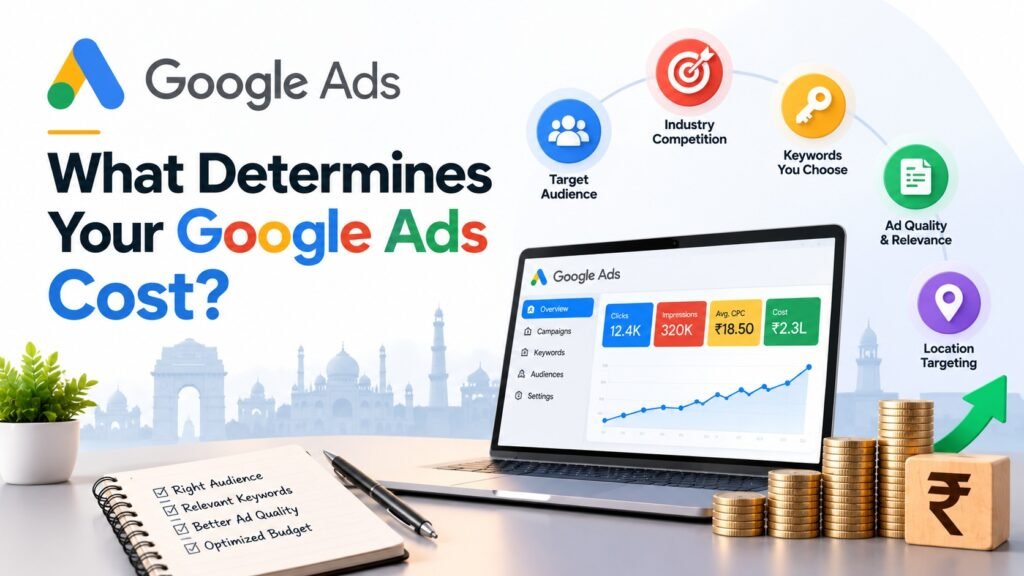
Google Ads cost is influenced by the interaction between the advertiser, the auction, and the person searching.
Google explains that Ad Rank considers factors including bid, ad and landing-page quality, competition, thresholds, and auction context such as location, device, time, search terms, and user signals.
Here are the major factors.
1. Keyword competition
The more advertisers competing for valuable search opportunities, the more competitive the auction can become.
Commercial keywords frequently attract stronger competition because businesses can connect them more directly to revenue.
But keyword competition should not be evaluated independently.
A keyword with high CPC can still be valuable if it generates high-quality customers.
2. Search intent
Search intent is one of the most important concepts in Google Ads.
Consider:
Informational
“how does Google Ads work”
Commercial
“best Google Ads agency”
Transactional
“hire Google Ads agency Ahmedabad”
The further a search moves toward a commercial action, the more valuable the visitor may be to a business.
However, this is not a rule that every transactional keyword will always cost more.
The auction determines actual pricing.
3. Quality Score and ad relevance
Quality Score is Google’s diagnostic score for Search keywords.
Its components include:
- Expected CTR
- Ad relevance
- Landing-page experience
Google specifically describes Quality Score as a diagnostic tool, rather than a KPI or a direct auction input. Google also says higher ad quality generally contributes to better performance, including better positions and lower costs.
Therefore, don’t treat Quality Score as a number you simply need to maximize.
Instead, improve the underlying factors:
- relevance
- user experience
- expected engagement
- landing-page usefulness
4. Landing page experience
Your advertisement makes a promise.
Your landing page needs to deliver on that promise.
If someone searches:
“Digital Marketing Course in Ahmedabad”
and clicks an advertisement, they should quickly find information about the relevant course.
A strong landing page should provide:
- clear headline
- relevant offer
- course/service information
- benefits
- trust signals
- relevant proof
- FAQs
- clear CTA
- mobile-friendly design
- fast loading experience
Sending every visitor to a generic homepage can create unnecessary friction.
5. Location targeting
Google Ads costs can vary by location because competition and demand vary by market.
For an Ahmedabad-focused business, targeting all of India may create unnecessary traffic.
A local campaign could instead focus on:
- Ahmedabad
- relevant surrounding areas
- locations actually served by the business
But location targeting should always reflect the real customer base.
6. Industry and customer value
Suppose Business A sells a ₹500 product.
Business B sells a service worth ₹1,00,000.
Business B may rationally be able to spend more to acquire a customer.
That means CPC cannot be judged without understanding customer economics.
The same ₹100 click can be:
expensive for one business
and
cheap for another.
7. Campaign type
Google Ads is not limited to traditional Search campaigns.
Depending on the account and objective, advertisers can work with campaign types such as:
- Search
- Performance Max
- Shopping
- Display
- Video
- App campaigns
Different campaign types can use different inventory and optimization approaches.
Performance Max, for example, is designed to access multiple Google inventory sources from one goal-based campaign.
Therefore, asking for a single “Google Ads average CPC” across every campaign type can be misleading.
8. Bidding strategy
Your bidding strategy determines how Google attempts to compete in auctions.
Depending on your objective, you may use strategies focused on:
- clicks
- conversions
- conversion value
- target CPA
- target ROAS
Smart Bidding uses machine learning to optimize bids for conversions or conversion value based on auction-time signals.
The important point is that automation works best when the account provides meaningful conversion data.
9. Conversion tracking
Poor conversion tracking can create poor optimization.
Imagine an education campaign generates:
- 100 clicks
- 20 enquiries
- 8 qualified prospects
- 3 counselling appointments
- 1 admission
If the account counts every enquiry equally, Google may not know which outcomes matter most to the business.
A mature measurement system therefore moves beyond:
“How many leads did we generate?”
toward:
“How many valuable customers did we acquire?”
10. Account optimization
Google Ads requires ongoing decision-making.
Important activities can include:
- search-term analysis
- negative keyword management
- ad testing
- landing-page testing
- budget allocation
- location analysis
- conversion tracking
- audience analysis
- bidding strategy evaluation
- campaign structure review
The objective is not to make changes every day simply for the sake of activity.
The objective is to identify meaningful opportunities and make decisions based on reliable data.
Google Ads Cost Per Click: What Does CPC Actually Mean?
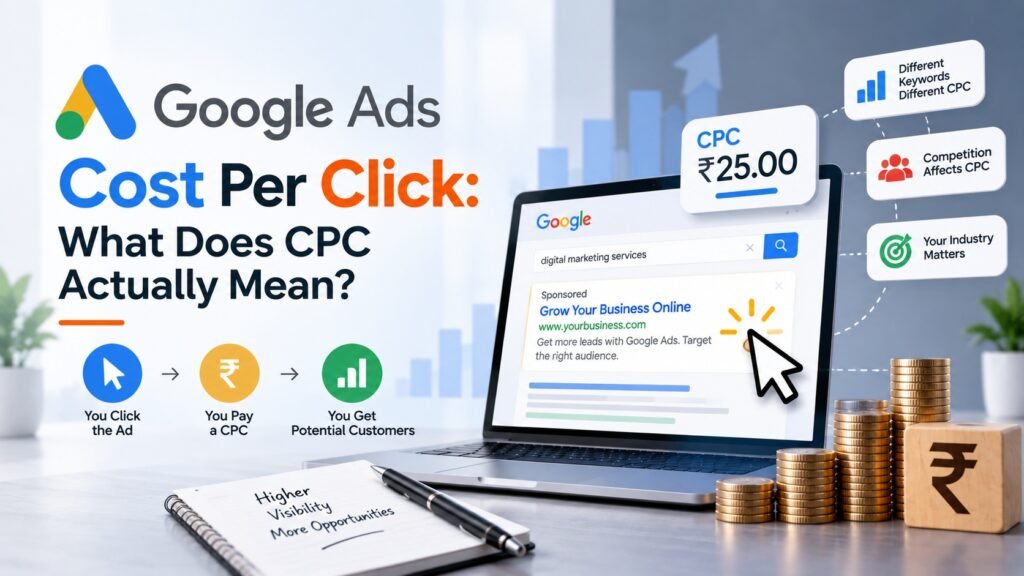
CPC stands for Cost Per Click.
If you spend ₹10,000 and receive 200 clicks:
Average CPC = ₹10,000 ÷ 200 = ₹50
Google defines average CPC using this same basic relationship: total click cost divided by total clicks.
But there are two CPC concepts you should understand.
Maximum CPC
The maximum CPC is the highest bid you are willing to make under a particular bidding setup.
Actual CPC
Actual CPC is what you are ultimately charged for the click.
It is often lower than the maximum amount you are willing to pay.
This distinction is important because:
Maximum CPC ≠ actual CPC.
How to Calculate Your Google Ads Budget
A useful Google Ads budget calculation starts with the desired business outcome.
Let’s use a hypothetical example.
Suppose:
- Monthly advertising budget = ₹60,000
- Average CPC = ₹60
- Estimated clicks = 1,000
- Landing-page conversion rate = 5%
Estimated leads:
1,000 × 5% = 50 leads
Estimated cost per lead:
₹60,000 ÷ 50 = ₹1,200
Now suppose 10% of those leads become customers.
Customers:
50 × 10% = 5 customers
Customer acquisition cost:
₹60,000 ÷ 5 = ₹12,000
Now the business can ask the question that actually matters:
“Can I profitably acquire a customer for ₹12,000?”
If the answer is yes, the campaign may have room to scale.
If the answer is no, the business needs to improve the economics.
How Much Should a Small Business Spend on Google Ads?
There is no universal small-business Google Ads budget.
A more useful framework is to start with:
Small test budget
Use enough budget to test:
- keywords
- offers
- landing pages
- targeting
- conversion tracking
Validation budget
Once initial data is available, identify which campaigns or search themes generate meaningful outcomes.
Scaling budget
Increase spending where the economics support additional volume.
For example, a local service business might choose a ₹20,000–₹30,000 monthly test budget, while another business may need ₹50,000, ₹1 lakh, or more because of higher CPCs or a larger geographic market.
The number itself is not the strategy.
The strategy is:
Budget → Data → Learning → Optimization → Scale
Google Ads Budget for Local Businesses
Local businesses often have an advantage: they do not necessarily need to advertise everywhere.
If your business serves only Ahmedabad, for example, you may not need to spend money reaching people who cannot realistically become customers.
Local Google Ads campaigns can focus on:
- service-related keywords
- location modifiers
- call conversions
- enquiry forms
- map/location intent
- high-intent searches
But avoid assuming that every “near me” search is automatically valuable.
Look at the actual customer journey.
Google Ads Management Cost in India
Google Ads management cost is separate from advertising spend.
For example:
Google Ads budget: ₹50,000/month
plus
Management fee: ₹15,000/month
means the business’s total marketing outlay is ₹65,000 before applicable taxes or other costs.
Management pricing can be structured in several ways.
1. Fixed monthly fee
You pay a predetermined amount every month.
Example:
₹15,000/month
2. Percentage of ad spend
The management fee is calculated as a percentage of advertising spend.
3. Hybrid model
A fixed base fee plus a percentage or performance component.
4. One-time setup + monthly management
An initial setup fee covers account creation or restructuring, followed by a recurring management fee.
What should Google Ads management include?
Before hiring an agency or freelancer, ask whether the fee includes:
- account audit
- campaign strategy
- keyword research
- campaign setup
- conversion tracking
- ad copy
- audience strategy
- negative keywords
- search-term analysis
- landing-page recommendations
- bid strategy
- budget management
- reporting
- monthly strategy reviews
- ongoing optimization
A low management fee is not necessarily better if very little work is included.
Likewise, a high fee is not automatically justified.
Evaluate the scope, expertise, measurement system, communication, and business results.
Google Ads Pricing vs Google Ads Management Cost
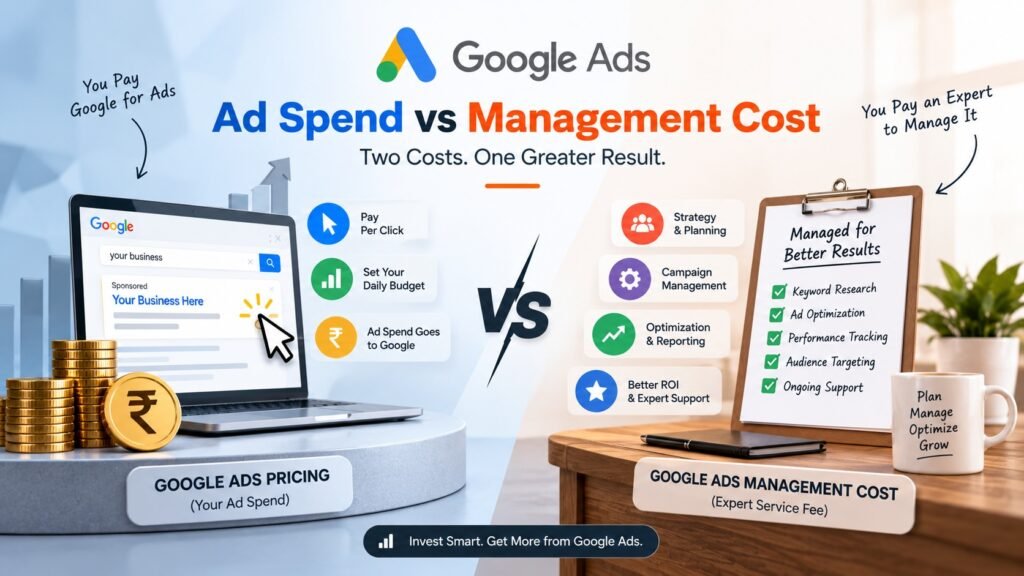
These terms are often confused.
Google Ads pricing
This generally refers to what you pay Google for advertising.
Google Ads management cost
This refers to what you pay the person or company managing the campaigns.
Example
Imagine:
| Cost | Monthly Amount |
|---|---|
| Google Ads advertising spend | ₹60,000 |
| Agency management fee | ₹15,000 |
| Total before applicable taxes/other costs | ₹75,000 |
Your Google Ads campaign therefore does not necessarily “cost ₹15,000.”
The ₹15,000 is the management fee.
The advertising spend is separate.
This distinction should always be clear before signing an agency agreement.
Does Google Ads Charge GST in India?
Tax treatment can depend on the Google entity involved, your account configuration, and the tax information associated with your account.
Google provides specific guidance for advertisers in India regarding GST and tax information.
Businesses should therefore check the applicable treatment for their account and consult their tax professional where necessary rather than assuming that one tax rule applies identically to every advertiser.
The important budgeting principle is:
Separate media spend, management fees, and applicable taxes when calculating your total marketing cost.
How AI Is Changing Google Ads Costs in 2026
Google Ads in 2026 is increasingly driven by machine learning and automation.
But AI has not introduced a fixed “AI Google Ads price.”
Instead, AI affects how campaigns:
- bid
- match searches
- find users
- select creative combinations
- use landing-page information
- optimize toward conversions
- allocate opportunities
This changes how marketers should manage campaigns.
1. Smart Bidding
Smart Bidding uses Google’s machine learning systems to optimize bids for conversions or conversion value.
Instead of manually setting a bid for every auction, advertisers can give Google an objective and allow the system to adjust bids using available signals.
This can be powerful, but the quality of your conversion data still matters.
If you optimize toward poor-quality conversions, automation can become very good at finding more of them.
2. Performance Max
Performance Max can access multiple Google advertising channels from one campaign.
This makes the campaign-management question broader than:
“What is my Search CPC?”
You may instead need to evaluate:
- total spend
- conversions
- conversion value
- CPA
- ROAS
- lead quality
- customer value
Google describes Performance Max as a goal-based campaign type designed to access Google’s advertising inventory across multiple channels.
3. AI Max for Search
AI Max is particularly important for understanding Search campaigns in 2026.
It is not simply another standalone campaign type.
Google describes AI Max for Search as a set of optimization features that can improve search-term matching, text customization, and landing-page selection.
This changes the role of keyword strategy.
The goal is increasingly not just:
“Build the biggest keyword list.”
It is:
“Clearly define the search intent, offer, audience, landing-page experience, and boundaries of the campaign.”
Advertisers should monitor how expanded matching affects:
- search terms
- conversions
- qualified leads
- cost
- landing pages
- customer quality
4. AI-generated creative
AI-powered features can help generate or customize advertising assets.
This can increase the number of creative combinations available for testing.
But marketers should still review generated messaging for:
- factual accuracy
- brand consistency
- offer accuracy
- compliance
- clarity
- landing-page alignment
Automation should support strategy—not replace it.
5. First-party data
Businesses increasingly need to understand their own customers.
Useful data can include:
- CRM records
- qualified leads
- purchases
- customer value
- repeat purchases
- sales outcomes
- offline conversions
The more accurately a business can distinguish a valuable customer from a low-value conversion, the more useful automated optimization can become.
6. Conversion-value optimization
Not every conversion has equal economic value.
For example:
Lead A = ₹500 expected value
Lead B = ₹10,000 expected value
Treating both as identical conversions can make optimization less aligned with the actual business objective.
Where appropriate, businesses should consider feeding better value signals into their advertising systems.
How to Reduce Google Ads Cost Without Reducing Lead Quality
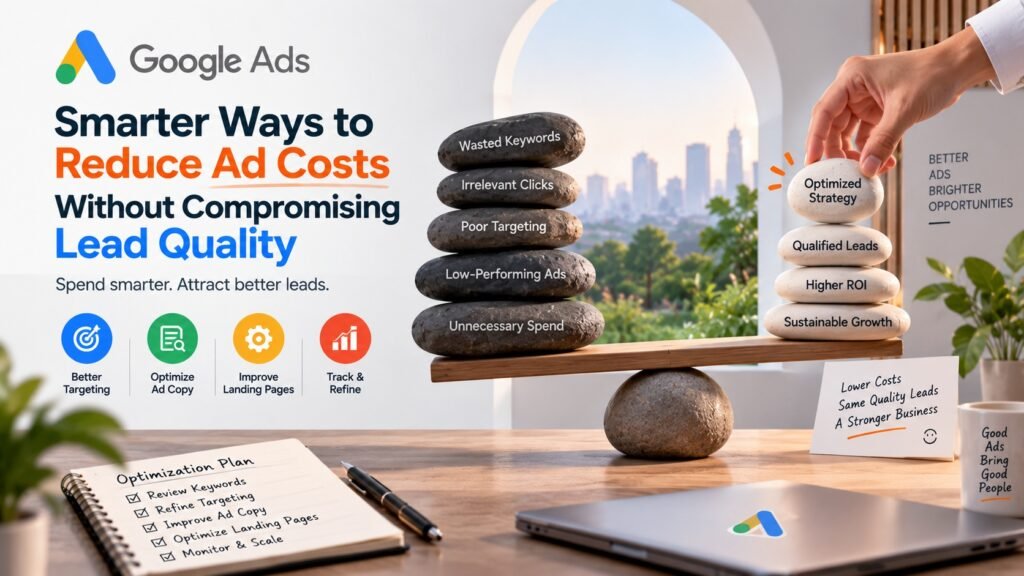
The wrong objective is:
“How do I get the cheapest CPC?”
The better objective is:
“How do I generate more valuable outcomes from my available budget?”
Here are practical ways to do it.
1. Reduce irrelevant searches
Review search terms regularly.
Identify queries that:
- have no commercial value
- are unrelated to the service
- indicate the wrong audience
- consistently generate poor-quality traffic
Use appropriate negative keywords and targeting controls where necessary.
2. Improve ad relevance
The advertisement should closely match the user’s search.
If someone searches for:
“digital marketing course Ahmedabad”
an advertisement specifically addressing that need is generally more relevant than a generic “Learn Digital Marketing” message.
3. Improve your landing page
A better landing page can improve campaign economics without reducing CPC.
Suppose you receive 1,000 clicks.
At a 2% conversion rate:
20 leads
At a 5% conversion rate:
50 leads
The traffic volume is identical.
The improvement comes from converting more of that traffic.
4. Improve lead quality
Not every enquiry should be treated as a successful conversion.
For lead-generation businesses, consider tracking:
- qualified leads
- sales calls
- appointments
- applications
- admissions
- purchases
where appropriate.
5. Improve conversion tracking
Make sure the conversion actions being used for optimization actually represent valuable business outcomes.
6. Focus budget on stronger opportunities
If one campaign consistently generates profitable customers and another produces low-quality leads, equal budget allocation may not make sense.
Use evidence to guide allocation.
7. Match keywords to customer intent
Don’t automatically target every keyword with high search volume.
A smaller number of highly relevant searches can sometimes be more valuable than a huge volume of loosely related traffic.
8. Test offers
Sometimes the problem is not the advertisement.
It is the offer.
Compare:
- free consultation
- demo
- limited-time offer
- course enquiry
- downloadable guide
- direct purchase
- callback request
depending on your business.
9. Improve mobile experience
A significant amount of search activity occurs on mobile devices.
Your landing page should therefore be easy to:
- read
- navigate
- submit
- call
- purchase from
on smaller screens.
10. Optimize for customer value
This is the most important point.
If you only optimize for CPC, you may accidentally sacrifice quality.
Optimize toward:
valuable customers.
Google Ads ROI: Is Google Ads Worth It in 2026?
Google Ads can be highly profitable for one business and unprofitable for another.
The platform itself does not determine profitability.
Your business economics do.
Two common measurements are ROI and ROAS.
ROI
A simplified ROI formula is:
ROI = (Return − Investment) ÷ Investment × 100
ROAS
ROAS = Revenue ÷ Advertising Spend
Suppose you spend:
₹50,000
and generate:
₹2,00,000 revenue
Your ROAS is:
₹2,00,000 ÷ ₹50,000 = 4
That means ₹4 of attributed revenue for every ₹1 of advertising spend.
But it does not automatically mean you earned ₹1,50,000 profit.
You still need to consider:
- product costs
- salaries
- agency fees
- technology
- shipping
- discounts
- refunds
- overhead
- taxes
This is why ROAS and profit should not be treated as the same thing.
How to Calculate Google Ads Cost Per Lead
The basic formula is:
CPL = Total Google Ads Spend ÷ Number of Leads
Example:
Google Ads spend = ₹40,000
Leads = 40
CPL:
₹40,000 ÷ 40 = ₹1,000
But there is an important second question:
How many of those 40 leads are actually qualified?
Suppose only 10 are qualified.
Your cost per qualified lead becomes:
₹40,000 ÷ 10 = ₹4,000
That is a much more meaningful business metric.
How to Calculate Google Ads Customer Acquisition Cost
Customer acquisition cost can be calculated as:
CAC = Total acquisition cost ÷ Number of new customers
Suppose:
- Google Ads spend = ₹60,000
- Management fee = ₹15,000
- Total acquisition cost = ₹75,000
- Customers = 5
CAC:
₹75,000 ÷ 5 = ₹15,000
If each customer generates enough contribution margin to justify ₹15,000 acquisition cost, the campaign may be economically sustainable.
CPC vs CPA vs CAC: What’s the Difference?
| Metric | Meaning | Main question |
|---|---|---|
| CPC | Cost per click | What am I paying for traffic? |
| CPL | Cost per lead | What am I paying for enquiries? |
| CPA | Cost per conversion/action | What am I paying for a conversion? |
| CAC | Customer acquisition cost | What does it cost to acquire a customer? |
| ROAS | Revenue ÷ ad spend | How much revenue comes from ad spend? |
| ROI | Return relative to investment | Is the overall investment profitable? |
For business decisions, CAC and profit can be more important than CPC.
Real-World Google Ads Budget Scenarios for 2026
The following are illustrative planning scenarios, not client case studies or performance guarantees.
Scenario 1: Local service business
Budget: ₹30,000/month
Possible focus:
- Search campaigns
- local keywords
- location targeting
- call tracking
- enquiry forms
- negative keywords
The main KPI could be qualified enquiries or booked appointments.
Scenario 2: Education business
Budget: ₹60,000/month
Potential focus:
- course-specific Search campaigns
- location targeting
- high-intent keywords
- landing pages
- enquiry tracking
- qualified-lead measurement
- admission tracking
The key metric should not be simply:
“How many leads did Google Ads generate?”
It should eventually become:
“How many relevant prospects became students?”
Scenario 3: E-commerce brand
Budget: ₹1,50,000/month
Potential metrics:
- revenue
- conversion rate
- ROAS
- average order value
- gross margin
- repeat purchase
- CAC
The campaign should be scaled according to profit economics, not revenue alone.
Scenario 4: B2B company
Budget: ₹1,00,000/month
A B2B campaign may need to track:
Click → Lead → Qualified Lead → Demo → Opportunity → Customer
Because the sales cycle may be long, evaluating success immediately after the first conversion can be misleading.
Advanced Google Ads Cost Optimization in the AI Era
The future of Google Ads management is not about manually controlling every possible setting.
It is increasingly about giving Google’s systems better inputs while maintaining strong business controls.
1. Build campaigns around business intent
Start with:
Who is the customer?
Then:
What are they searching for?
Then:
What action should they take?
Then:
What is that customer worth?
This produces a stronger strategy than starting with a keyword list.
2. Give automation better conversion signals
If your system only knows that someone submitted a form, it may not understand whether that person became a customer.
Where technically appropriate, connect meaningful downstream outcomes.
3. Review search-term quality
Automation can expand reach.
That makes search-term analysis increasingly important.
Look for:
- irrelevant queries
- unexpected intent
- valuable new themes
- low-quality traffic
- emerging opportunities
4. Review landing-page selection
As Google’s automated systems use more landing-page and website context, make sure important pages are:
- clear
- relevant
- accurate
- commercially useful
- conversion-friendly
5. Don’t over-optimize too early
A campaign needs enough information before you make major strategic decisions.
Constantly changing:
- budgets
- bids
- keywords
- targeting
- landing pages
can make it difficult to understand what actually caused performance changes.
Google Ads Cost: What Data Should You Track?
A professional campaign should track more than clicks.
Traffic metrics
- impressions
- clicks
- CTR
- CPC
Conversion metrics
- conversions
- conversion rate
- CPL
- CPA
Business metrics
- qualified leads
- customers
- CAC
- revenue
- profit
- customer lifetime value
Efficiency metrics
- ROAS
- ROI
- revenue per customer
- profit per customer
A mature reporting structure therefore looks like:
Impressions → Clicks → Leads → Qualified Leads → Customers → Revenue → Profit
Common Google Ads Budget Mistakes
Mistake 1: Choosing a budget because a competitor uses it
Your competitor’s economics are different from yours.
Mistake 2: Looking only at CPC
Cheap clicks are not necessarily valuable clicks.
Mistake 3: Sending every ad to the homepage
A specific search deserves a relevant destination.
Mistake 4: Counting every enquiry as a customer
A lead is not a sale.
Mistake 5: Ignoring conversion tracking
Without reliable measurement, optimization becomes guesswork.
Mistake 6: Increasing budget before fixing the funnel
More traffic does not fix a poor landing page or weak offer.
Mistake 7: Using industry averages as guarantees
Benchmarks are planning references, not promises.
Mistake 8: Treating Quality Score as the final business KPI
Quality Score is a diagnostic tool, not a measure of profitability.
Mistake 9: Assuming AI eliminates campaign management
Automation can handle more of the optimization process, but businesses still need strategy, measurement, creative oversight, and commercial judgment.
Mistake 10: Confusing management fee with ad spend
Always calculate total acquisition cost correctly.
How to Decide Your Ideal Google Ads Budget
Use this five-step framework.
Step 1: Calculate customer value
How much gross profit does one customer generate?
Step 2: Set an acceptable CAC
How much can you spend to acquire that customer while remaining profitable?
Step 3: Estimate conversion rate
What percentage of relevant clicks become leads or purchases?
Step 4: Estimate CPC
Use Google Keyword Planner and relevant historical campaign data rather than relying entirely on generic online averages. Google describes Keyword Planner as a tool for discovering keywords and obtaining search-volume, cost, and forecast information.
Step 5: Calculate the required traffic
Work backward from the number of customers you need.
For example:
10 customers
with a
10% lead-to-customer rate
requires approximately:
100 qualified leads
If your landing page converts 5% of clicks:
100 ÷ 5% = 2,000 clicks
If CPC averages ₹50:
2,000 × ₹50 = ₹1,00,000
This is a planning model—not a prediction.
Google Ads Keyword Planner: The Best Starting Point for Cost Estimates
If you want to estimate Google Ads CPC for your actual market, don’t rely exclusively on articles listing “average CPC.”
Use Google Keyword Planner alongside your own campaign data.
It can help with:
- keyword discovery
- search-volume estimates
- cost estimates
- forecasts
- bid planning
Google notes that Keyword Planner forecasts incorporate factors such as bids, budget, seasonality, and historical ad-quality information.
For an Ahmedabad-based business, for example, you could investigate location-specific keyword demand rather than assuming that a national CPC benchmark applies to your campaign.
Is Google Ads Better Than SEO?
Google Ads and SEO solve different problems.
Google Ads
Can provide paid visibility when you have budget and relevant search demand.
SEO
Can generate organic visibility without paying Google for every click.
A strong digital marketing strategy may use both.
For example:
SEO → long-term organic visibility
Google Ads → paid search visibility
Remarketing → reconnect with previous visitors where appropriate
Content → educate users
Conversion optimization → turn traffic into customers
The right mix depends on the business.
Google Ads vs Other Advertising Costs
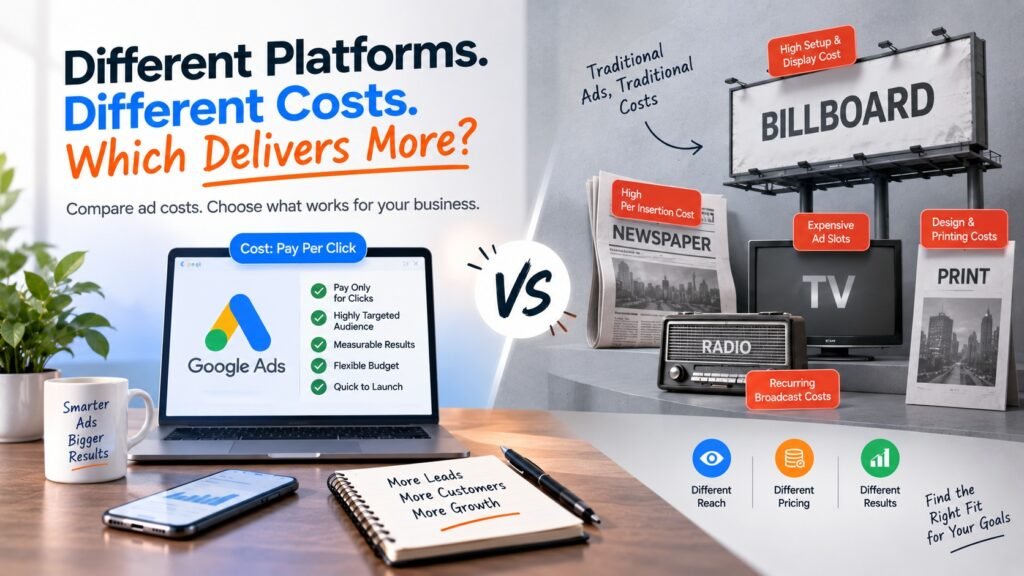
Do not compare platforms only by CPC.
For example:
A social platform might produce a ₹10 click.
Google Search might produce a ₹60 click.
That does not automatically mean the social platform is six times better.
The traffic intent may be completely different.
Someone searching:
“hire digital marketing agency Ahmedabad”
has actively expressed a need.
Someone scrolling through social media and seeing a marketing advertisement may not currently be looking for that service.
Therefore, compare platforms using:
Cost → Conversion → Qualified Lead → Customer → Revenue → Profit
What Is a Good Google Ads CPC in 2026?
There is no universal good CPC.
A useful CPC depends on:
- conversion rate
- lead quality
- customer value
- profit margin
- sales cycle
- customer acquisition cost
For example:
Campaign A
CPC = ₹20
100 clicks
2 customers
Campaign B
CPC = ₹80
100 clicks
10 customers
Campaign B has a CPC four times higher.
But it may have dramatically better economics.
This is why “How can I get the lowest CPC?” is often the wrong question.
Ask:
“What CPC can my business afford while still acquiring profitable customers?”
What Is a Good Google Ads ROI?
There is no universal ROI percentage that applies to every business.
A profitable SaaS company, e-commerce company, education institute, and local service business may all have different acceptable acquisition economics.
Instead of copying another company’s ROI target, calculate your own:
Customer Revenue
minus
Product/Service Delivery Cost
minus
Customer Acquisition Cost
minus
Other Relevant Costs
equals
Contribution/Profit
That is the number that should influence scaling decisions.
Frequently Asked Questions
How much does Google Ads cost in 2026?
There is no fixed Google Ads cost in 2026. You choose an average daily campaign budget, while actual CPC and total spend depend on auction conditions, targeting, keywords, campaign type, bidding, and other factors. Google allows campaign budgets to fluctuate by day while managing spending over the month.
How much does Google Ads cost per click?
Google Ads CPC varies by keyword, industry, location, competition, auction context, and campaign settings. Indian third-party benchmarks commonly report Search CPC ranges such as ₹20–₹150, but actual CPC can be significantly different for an individual campaign.
What is the average Google Ads CPC in India?
There is no official single India-wide CPC. Third-party 2026 sources report different benchmarks, including approximately ₹20–₹150 for Search ads and broader ranges depending on industry. These should be treated as indicative rather than guaranteed pricing.
Is there a minimum budget for Google Ads?
There is no single universal monthly budget that every advertiser must spend. You set your campaign’s average daily budget. However, your budget should be large enough to generate sufficient data for your business objective.
How much should a small business spend on Google Ads?
The appropriate budget depends on CPC, conversion rate, acceptable customer acquisition cost, customer value, market size, and available cash flow. A controlled test followed by evidence-based scaling is usually more useful than copying another business’s budget.
How much does Google Ads management cost in India?
Management fees vary depending on the provider, account size, campaign complexity, services included, and pricing model. Agencies and freelancers may use fixed monthly fees, percentage-of-spend models, hybrid pricing, or setup plus recurring management.
Is Google Ads worth it in 2026?
Google Ads can be worth it when the campaign produces customers at an economically sustainable acquisition cost. The answer depends on your conversion rate, customer value, margins, sales process, and campaign quality—not simply your CPC.
How can I reduce my Google Ads CPC?
Improve relevance between search terms, ads, and landing pages; remove irrelevant traffic; improve targeting; use suitable bidding strategies; and optimize campaigns based on reliable conversion data. Google notes that higher ad quality generally supports better advertising performance.
Why is my Google Ads CPC so high?
Possible reasons include strong keyword competition, high-value commercial intent, location, auction context, industry economics, bidding strategy, and campaign quality. Compare your CPC with conversion rate and customer value before deciding that the CPC is actually too high.
Can I run Google Ads with ₹500 per day?
Yes, a ₹500 average daily budget can be set as a planning level, but whether it is sufficient depends on CPC, market size, campaign objective, and required conversion volume.
How much does Google Ads cost for a local business?
There is no fixed local-business price. A local business should generally build its budget around the number of customers required, expected conversion rate, local CPCs, and acceptable acquisition cost.
Does Quality Score directly determine how much I pay?
Quality Score is a diagnostic metric rather than a direct auction input. Google says its underlying ad-quality factors can influence advertising performance, including position and cost.