Introduction
If you’re new to marketing, one of the biggest questions you’ll face is: Traditional Marketing vs Digital Marketing — which one actually works better today?
Many beginners feel confused because both methods are still widely used. You see billboards, newspaper ads, and TV commercials every day. At the same time, businesses are investing heavily in social media, Google ads, and SEO.
The reality in 2026 is simple: marketing has evolved, but not completely replaced old methods. Instead, the balance has shifted.
In this guide, we’ll break down Traditional Marketing vs Digital Marketing in the simplest way possible. You’ll learn:
- What each method really means
- How they differ
- Real-world examples
- Which one gives better ROI
- And most importantly — which one you should choose
Whether you’re a student, freelancer, or business owner, this article will give you a clear direction.
What is Traditional Marketing?
Marketing is the process of identifying, creating, communicating, and delivering value to customers. It includes a mix of strategies like advertising, public relations, sales promotions, and direct marketing. The ultimate goal of marketing is not just to sell a product but to build long-term relationships with customers by understanding their needs and preferences.
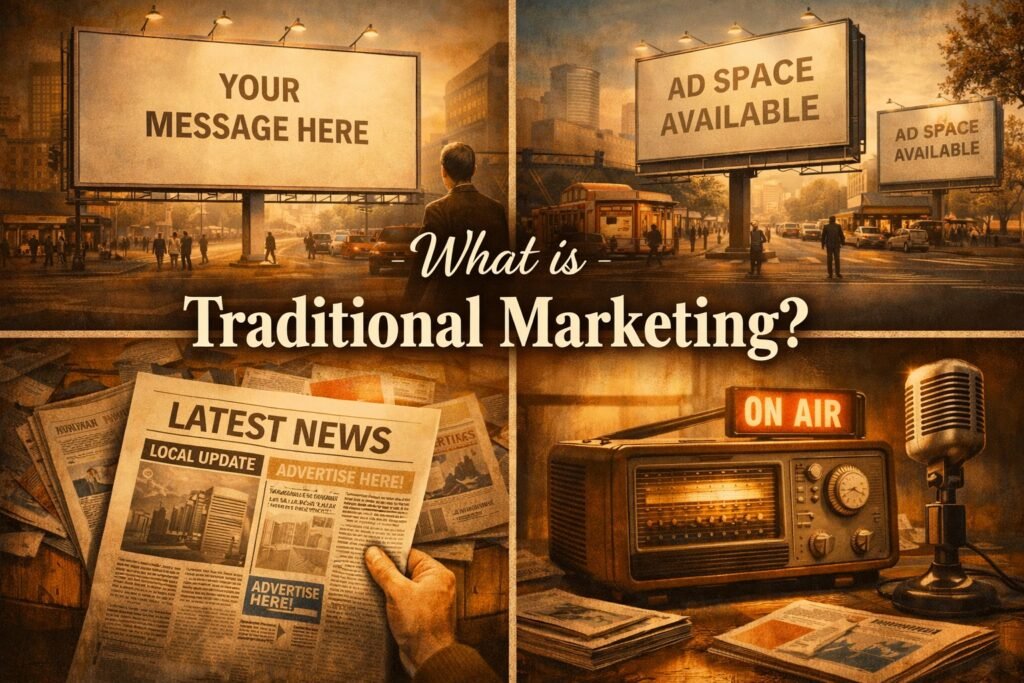
It refers to promoting products or services using offline channels.
Common Traditional Marketing Channels:
- TV advertisements
- Radio ads
- Newspaper & magazine ads
- Billboards & hoardings
- Flyers & brochures
Real-Life Example
A local jewelry store in Ahmedabad runs a newspaper ad during Diwali to attract nearby customers.
This works because:
- It targets a local audience
- Builds brand trust
- Reaches people who may not be online
Key Characteristics:
- One-way communication
- Limited targeting
- High cost
- Hard to measure results
Traditional marketing still plays a role, especially in mass awareness campaigns.
What is Digital Marketing?
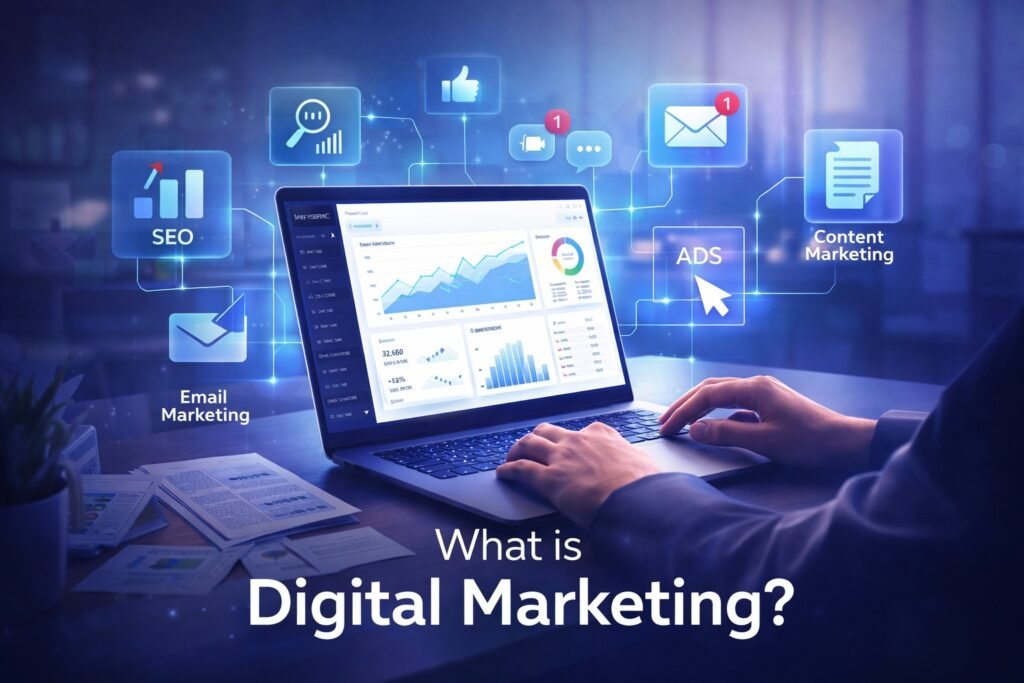
It is the promotion of products or services using online platforms and digital channels.
Main Digital Marketing Channels:
- Search Engine Optimization (SEO)
- Social Media Marketing
- Google Ads (PPC)
- Email Marketing
- Content Marketing
Real-Life Example
A clothing brand runs Instagram ads targeting women aged 18–30 in Gujarat.
This works because:
- It targets a specific audience
- Tracks clicks and conversions
- Optimizes campaigns instantly
Why Digital Marketing is Growing Fast:
- People spend more time online
- Businesses want measurable results
- Lower cost compared to traditional marketing
Difference Between Digital Marketing and Traditional Marketing
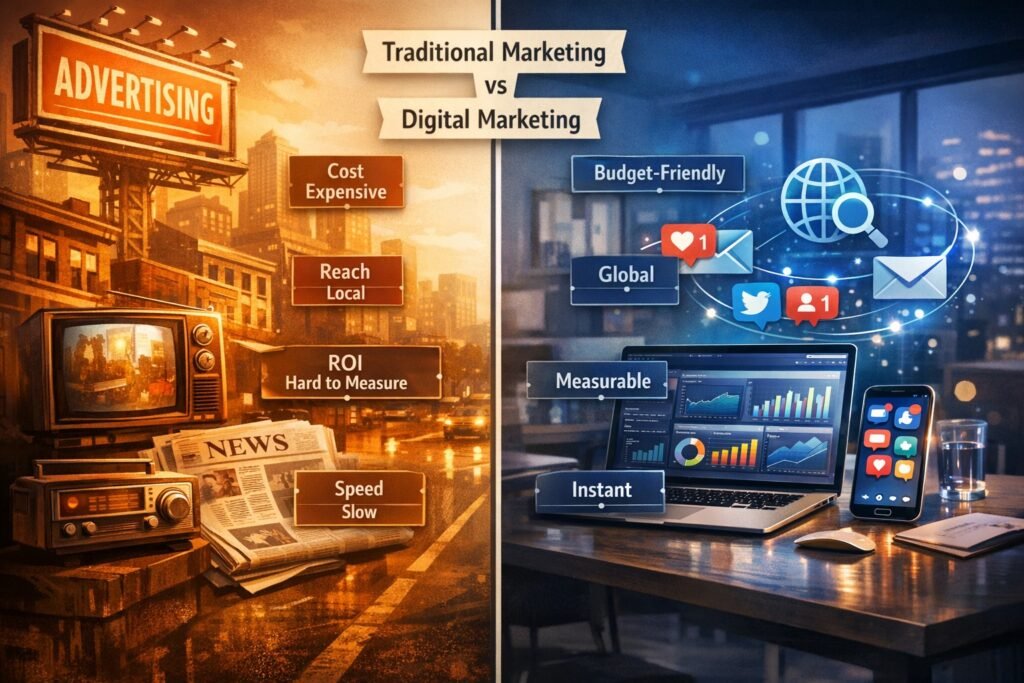
Here is a clear comparison:
|
Basis |
Traditional Marketing |
Digital Marketing |
|
Cost |
Expensive |
Budget-friendly |
|
Reach |
Local/Regional |
Global |
|
Targeting |
Broad |
Highly specific |
|
ROI |
Hard to measure |
Easily measurable |
|
Interaction |
One-way |
Two-way |
|
Speed |
Slow |
Instant |
|
Analytics |
Limited |
Real-time |
|
Flexibility |
Low |
High |
Key Takeaway:
Digital marketing gives control, data, and flexibility — which traditional marketing lacks.
Types of Digital Marketing
Understanding the types of digital marketing is crucial if you want to grow online.
1. Search Engine Optimization (SEO)
- Improves website ranking on Google
- Brings organic traffic
Example: Ranking a blog for “best shoes in India”
2. Social Media Marketing
- Promotion through platforms like Instagram, Facebook, LinkedIn
- Great for engagement and brand awareness
3. Pay-Per-Click Advertising (PPC)
- Paid ads on Google and social media
- Instant traffic
4. Content Marketing
- Blogs, videos, infographics
- Builds trust and authority
5. Email Marketing
- Sending offers, newsletters
- High conversion channel
Traditional Marketing vs Digital Marketing: Which Wins in 2026?
Let’s directly answer the big question.
1. Cost-Effectiveness
- Traditional: High cost (TV, print)
- Digital: Start with small budget
Winner: Digital Marketing
2. Targeting
- Traditional: Mass audience
- Digital: Specific targeting
Winner: Digital Marketing
3. Growth Potential
- Traditional: Limited scalability
- Digital: Unlimited reach
Winner: Digital Marketing
4. Measurability
- Traditional: Guesswork
- Digital: Data-driven
Winner: Digital Marketing
Digital Marketing Examples vs Traditional Marketing Examples
Let’s compare practical cases.
Digital Marketing Example:
- Instagram ad for a fitness brand
- Google SEO blog ranking
- YouTube ads
Traditional Marketing Example:
- Newspaper advertisement
- Billboard near highway
- TV commercial
Comparison:
|
Scenario |
Traditional |
Digital |
|
Promote local shop |
Newspaper ad |
Google Maps SEO |
|
Launch product |
TV ad |
Instagram campaign |
|
Generate leads |
Flyers |
Facebook Ads |
Why Businesses Are Shifting to Digital Marketing
Here’s what I’ve seen working with businesses:
1. Lower Cost
You don’t need lakhs to start.
2. Better Targeting
Reach exactly the right audience.
3. Measurable Results
Track:
- Clicks
- Leads
- Sales
4. Global Reach
Sell beyond your city or country.
5. Higher ROI
Every rupee can be optimized.
If you’re serious about learning this skill, consider a Digital Marketing Course in Ahmedabad or Digital Marketing Course in Surat to build practical expertise.
When Traditional Marketing Still Works
Let’s be realistic — traditional marketing isn’t dead.
It works best for:
- Local businesses
- Rural areas
- Brand awareness campaigns
Example:
A cement company advertising on TV for nationwide visibility.
Best Strategy – Combining Traditional + Digital Marketing
The smartest approach is hybrid marketing.
Example Strategy:
- Use billboards for awareness
- Use social media ads for conversions
This is called omnichannel marketing.
Future of Marketing in 2026
AI Marketing
Automation tools and AI-generated content
Voice Search
People search using voice assistants
Personalization
Users expect tailored experiences
Data-Driven Marketing
Decisions based on analytics, not guesswork
Conclusion
When we compare Traditional Marketing vs Digital Marketing, the difference becomes clear, especially in 2026 where data, speed, and precision matter more than ever. Traditional marketing still holds value for brand awareness and mass reach, but it lacks the flexibility and measurable insights that modern businesses need to grow efficiently.
Digital marketing, on the other hand, offers powerful advantages. It allows businesses to target the right audience, track performance in real time, and optimize campaigns for better results. Whether it’s a small business, freelancer, or startup, digital strategies provide a level playing field where growth is driven by smart execution rather than just budget.
For beginners, this shift creates a huge opportunity. You don’t need massive resources to start—you need the right approach. By learning and applying digital marketing along with SEO Tips for Beginners, you can build long-term visibility, attract the right audience, and generate consistent results.
As competition continues to increase, those who adapt to digital will stay ahead. If your goal is growth, scalability, and measurable success, digital marketing is not just the better option—it’s the smarter path forward for your career or business.
FAQ SECTION
Which is better digital or traditional marketing?
Digital marketing is generally better than traditional marketing because it offers precise targeting, measurable results, and lower costs. Businesses can track user behavior, optimize campaigns instantly, and reach global audiences. However, traditional marketing still works for mass awareness and offline branding. For most businesses in 2026, digital marketing provides higher ROI and better growth opportunities.
What are examples of digital marketing?
Examples of digital marketing include search engine optimization (SEO), social media advertising, Google Ads, email marketing, content marketing, and influencer marketing. For instance, a business running Instagram ads or ranking a blog on Google is using digital marketing. These methods help reach targeted audiences, increase engagement, and generate leads or sales more effectively.
What are examples of traditional marketing?
Traditional marketing examples include newspaper advertisements, TV commercials, radio ads, billboards, brochures, and direct mail campaigns. For example, a company placing a full-page ad in a newspaper or running a TV ad during prime time is using traditional marketing. These methods are mainly used for brand awareness but offer limited targeting and tracking capabilities.
What are the types of digital marketing?
The main types of digital marketing include SEO (Search Engine Optimization), social media marketing, pay-per-click advertising (PPC), content marketing, and email marketing. Each type serves a different purpose, such as driving organic traffic, building brand awareness, or generating leads. Businesses often combine multiple digital marketing strategies to achieve better results and maximize growth.
Can small businesses use digital marketing?
Yes, digital marketing is highly suitable for small businesses because it allows them to compete with larger brands using smaller budgets. With tools like social media ads, local SEO, and email marketing, small businesses can target specific audiences and track results easily. It helps them generate leads, increase visibility, and grow their business without heavy investment.
Is digital marketing the future?
Yes, digital marketing is considered the future of marketing because more people are using the internet, smartphones, and online platforms daily. Businesses are shifting online to reach customers more effectively and measure performance accurately. With advancements in AI, automation, and data analytics, digital marketing will continue to grow and become essential for long-term business success.
Why is digital marketing more effective than traditional marketing?
Digital marketing is more effective because it allows precise audience targeting, real-time performance tracking, and better cost control. Businesses can analyze user behavior, adjust campaigns instantly, and improve results continuously. Unlike traditional marketing, digital strategies focus on engagement and conversions, making them more efficient for generating leads, sales, and long-term customer relationships.
How does digital marketing help in business growth?
Digital marketing helps businesses grow by increasing online visibility, attracting targeted audiences, and generating consistent leads. Strategies like SEO, social media marketing, and paid ads drive traffic and conversions. It also enables businesses to track performance, understand customer behavior, and optimize campaigns, resulting in better decision-making and sustainable long-term growth.
Can digital marketing replace traditional marketing completely?
Digital marketing is rapidly replacing traditional methods in many industries, but it may not completely eliminate them. Traditional marketing still works in specific scenarios like rural markets or mass awareness campaigns. However, for most businesses, digital marketing has become the primary channel due to its flexibility, scalability, and ability to deliver measurable results.
What skills are required to learn digital marketing?
To learn digital marketing, you need skills like content creation, basic SEO knowledge, social media management, and data analysis. Communication and creativity are also important for creating engaging campaigns. Beginners can start with simple tools and gradually learn advanced strategies like paid advertising and analytics to improve their expertise and career opportunities.