
ChatGPT has completely changed how SEO and content marketing works…
A few years ago, creating an SEO blog meant hours of keyword research, competitor analysis, outline planning, writing, editing, formatting, and optimization. Today, with ChatGPT and other AI SEO tools, a smart marketer can complete many of these steps faster.
But here is the most important truth:
ChatGPT is not replacing SEO experts — it is making smart marketers more powerful.
SEO is not only about writing words. It is about understanding search intent, user psychology, Google ranking signals, brand positioning, content quality, authority, trust, and business goals. ChatGPT can help you work faster, think better, organize ideas, and improve productivity — but the real strategy still comes from humans.
Google’s own guidance says its ranking systems prioritize helpful, reliable, people-first content, not content made only to manipulate rankings. Google also says generative AI can be useful for research and content structure, but using AI to generate many low-value pages may violate spam policies.
So, the smart approach is simple:
Use ChatGPT as your SEO assistant, not as your complete SEO replacement.
This guide will show you exactly how to use ChatGPT for SEO, keyword research, content strategy, blog writing, on-page optimization, AI Overview optimization, and content workflows — in a practical way.
How Can ChatGPT Help in SEO?
ChatGPT can help in SEO by speeding up research, content planning, writing, optimization, and workflow automation. It is useful for beginners, bloggers, freelancers, agencies, and business owners who want to create better SEO content faster.
ChatGPT can help with:
- Keyword research: Generate seed keywords, long-tail keywords, semantic keywords, and topic ideas.
- Search intent mapping: Understand whether users want information, comparison, buying guidance, or tutorials.
- SEO content briefs: Create blog outlines, H2/H3 structures, and writing direction.
- Meta tags: Write SEO titles, meta descriptions, and social snippets.
- Topical clusters: Plan pillar pages, supporting blogs, and internal linking.
- Content optimization: Improve headings, readability, FAQs, snippet answers, and semantic coverage.
- AI Overview preparation: Create direct-answer sections, definitions, step-by-step formats, and structured explanations.
However, ChatGPT should not be used blindly. You still need human fact-checking, SERP analysis, brand experience, originality, examples, and final editing.
What Is ChatGPT and How Does It Help SEO?
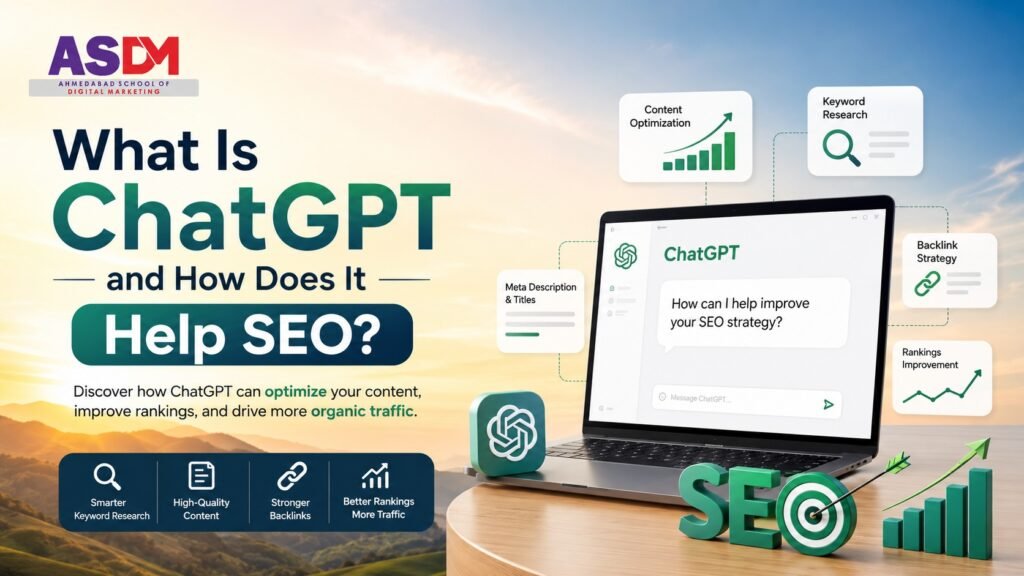
ChatGPT is an AI language model that understands natural language and generates human-like responses based on prompts. In simple words, you ask it a question or give it an instruction, and it helps you create ideas, outlines, drafts, summaries, prompts, strategies, and explanations.
For SEO, ChatGPT works like a smart assistant.
It can help you:
- Understand a topic quickly
- Generate content ideas
- Create keyword variations
- Build blog structures
- Improve readability
- Create FAQs
- Write meta descriptions
- Simplify technical concepts
- Repurpose content for social media
- Create content workflows
But ChatGPT does not automatically know live search volume, real-time rankings, current SERP competition, or your website’s exact SEO data unless you provide that information or connect it with tools.
That is why the best SEO workflow is:
SEO tools + ChatGPT + human strategy
For example, you can use Google Search Console, Google Keyword Planner, Semrush, Ahrefs, or other SEO tools for data. Then use ChatGPT to organize that data into content plans, briefs, outlines, and optimization ideas.
Google’s SEO Starter Guide explains that SEO helps search engines understand your content and helps users find your site through search. ChatGPT can support this process, but the foundation still remains clear content, crawlability, helpfulness, and user value.
Benefits of Using ChatGPT for SEO
Using ChatGPT for SEO is not about “shortcut ranking.” It is about building a smarter workflow.
1. Faster SEO Research
Earlier, SEO research took many hours. Now, ChatGPT can help you brainstorm topic angles, keyword variations, search intent, audience questions, and content gaps quickly.
Example:
Instead of manually thinking of 50 blog ideas around “AI SEO,” you can ask ChatGPT:
“Give me 50 SEO blog topics around AI SEO for beginners, freelancers, bloggers, and agency owners. Group them by search intent.”
This gives you a starting point in minutes.
2. Better Content Ideation
Many bloggers struggle because they write random topics. ChatGPT can help you organize topics into proper clusters.
For example, instead of writing only one blog on “ChatGPT for SEO,” you can build a full cluster:
- How to use ChatGPT for SEO
- Best ChatGPT SEO prompts
- ChatGPT keyword research guide
- AI content optimization checklist
- Can AI replace SEO experts?
- How AI is changing digital marketing education
This improves topical authority.
3. Improved Content Structure
A good SEO blog is not just long. It is well-structured.
ChatGPT can help you create:
- H1 title
- H2 and H3 structure
- FAQ section
- Key takeaways
- Step-by-step workflow
- Featured snippet section
- Internal linking suggestions
This is especially useful for beginners who do not know how to structure a professional SEO article.
4. Productivity Increase
A content marketer can use ChatGPT to reduce repetitive work.
For example:
- Generate 10 title variations
- Rewrite meta descriptions
- Summarize competitor pages
- Create social captions from blog content
- Convert long blogs into LinkedIn posts
- Create email newsletter drafts
- Prepare content briefs for writers
This allows SEO teams to focus more on strategy, quality, and results.
5. Better Beginner Learning
For students and beginners, ChatGPT can act like a learning partner.
You can ask:
“Explain search intent like I am a beginner.”
Or:
“Give me an example of informational vs commercial keyword intent.”
This makes SEO learning faster and more practical.
How to Use ChatGPT for Keyword Research
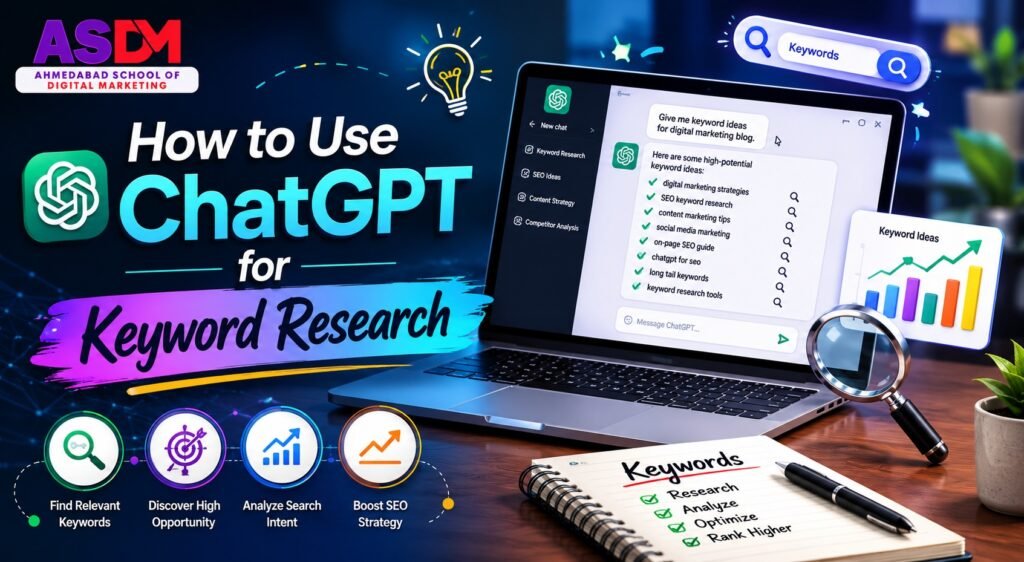
ChatGPT can be very helpful for keyword research, but you must understand one thing clearly:
ChatGPT is not a live keyword research tool by default.
It can generate keyword ideas, but it may not provide accurate search volume, CPC, keyword difficulty, or live ranking competition unless connected with real data.
So, use ChatGPT for keyword discovery and organization — not as your only data source.
Step 1: Generate Seed Keywords
Start with your main topic.
Prompt:
“Give me seed keyword ideas for the topic ‘how to use ChatGPT for SEO’. Include beginner, blogger, freelancer, agency, and business owner angles.”
Possible output:
- ChatGPT for SEO
- AI SEO tools
- ChatGPT SEO prompts
- AI content writing
- ChatGPT keyword research
- SEO content strategy using ChatGPT
- AI content marketing strategy
Step 2: Generate Long-Tail Keywords
Long-tail keywords are more specific and often easier to rank for.
Prompt:
“Generate 30 long-tail keywords around ‘ChatGPT for SEO’ with informational search intent.”
Examples:
- how to use ChatGPT for SEO
- how to use ChatGPT for keyword research
- best ChatGPT prompts for SEO content writing
- how bloggers can use ChatGPT for SEO
- how to create SEO content strategy using ChatGPT
Step 3: Map Search Intent
Search intent means the reason behind the search.
For SEO, this is extremely important.
Prompt:
“Classify these keywords by search intent: informational, commercial, navigational, or transactional.”
Example:
| Keyword | Search Intent |
|---|---|
| how to use ChatGPT for SEO | Informational |
| best AI SEO tools | Commercial |
| ChatGPT SEO prompts | Informational |
| AI SEO course | Transactional |
| ChatGPT content strategy | Informational |
Step 4: Generate Semantic Keywords
Semantic keywords help Google understand the overall topic.
For “ChatGPT for SEO,” semantic terms may include:
- search intent
- content brief
- topical authority
- NLP optimization
- AI content workflow
- SERP analysis
- featured snippet
- internal linking
- content clusters
- EEAT
- helpful content
Prompt:
“Give me semantic SEO terms and NLP entities related to ‘how to use ChatGPT for SEO’.”
Step 5: Extract FAQ Ideas
FAQs are powerful for People Also Ask, voice search, AI search, and AI Overview-style answers.
Prompt:
“Give me 20 FAQ questions people may ask about using ChatGPT for SEO. Make them beginner-friendly and search-friendly.”
Examples:
- Can ChatGPT do keyword research?
- Is ChatGPT good for SEO blogs?
- Can ChatGPT replace SEO experts?
- How do agencies use ChatGPT for SEO?
- Is AI content safe for Google ranking?
Keyword Research Limitation
ChatGPT can help with keyword ideas, but always validate important keywords using real SEO tools.
Check:
- Search volume
- Keyword difficulty
- SERP competition
- Current ranking pages
- User intent
- Content freshness
- Business relevance
This is where human SEO judgment becomes important.
How to Use ChatGPT for Content Strategy

Content strategy means deciding what to publish, why to publish it, how it connects to business goals, and how it builds topical authority.
ChatGPT can help create a strong SEO content strategy if you guide it properly.
1. Build Topic Clusters
A topic cluster is a group of related pages around one main topic.
Example cluster for AI SEO:
Pillar Page:
- How to Use ChatGPT for SEO
Supporting Blogs:
- Best ChatGPT SEO Prompts
- ChatGPT Keyword Research Guide
- AI Content Optimization Checklist
- How to Use AI for SEO Content Strategy
- Can AI Replace SEO Experts?
- AI SEO Tools for Beginners
- SEO Automation with ChatGPT
This helps search engines understand that your website has depth on the subject.
Google’s guidance for generative AI search says foundational SEO best practices remain relevant, and valuable, non-commodity content is important for long-term visibility in AI-powered search experiences.
2. Create a Content Calendar
Prompt:
“Create a 30-day SEO content calendar for a digital marketing education website around AI SEO, ChatGPT, content strategy, and beginner SEO learning.”
You can ask ChatGPT to include:
- Blog title
- Target keyword
- Search intent
- Funnel stage
- Internal link target
- CTA idea
- Suggested FAQ
3. Plan Internal Linking
Internal linking helps users and search engines discover related pages.
Prompt:
“Create an internal linking plan for a blog on ‘how to use ChatGPT for SEO’. Suggest anchor texts and related pages.”
Example internal anchors:
- AI based digital marketing course Ahmedabad
- Can AI Replace Digital Marketers?
- How AI Is Changing Digital Marketing Education
- Digital Marketing Institute in Surat
Use them naturally. Do not force keywords everywhere.
4. Create AI Overview-Friendly Content
For AI Overview, content should be easy to extract.
Use:
- Direct answers
- Clear definitions
- Step-by-step workflows
- Short paragraphs
- Bullet lists
- Comparison tables
- FAQs
- Expert opinion
- Original examples
Google says there are no special requirements to appear in AI Overviews or AI Mode beyond being eligible for Search and following SEO fundamentals, but strong, clear, useful content improves your chances of being understood and surfaced.
How to Use ChatGPT for Blog Writing
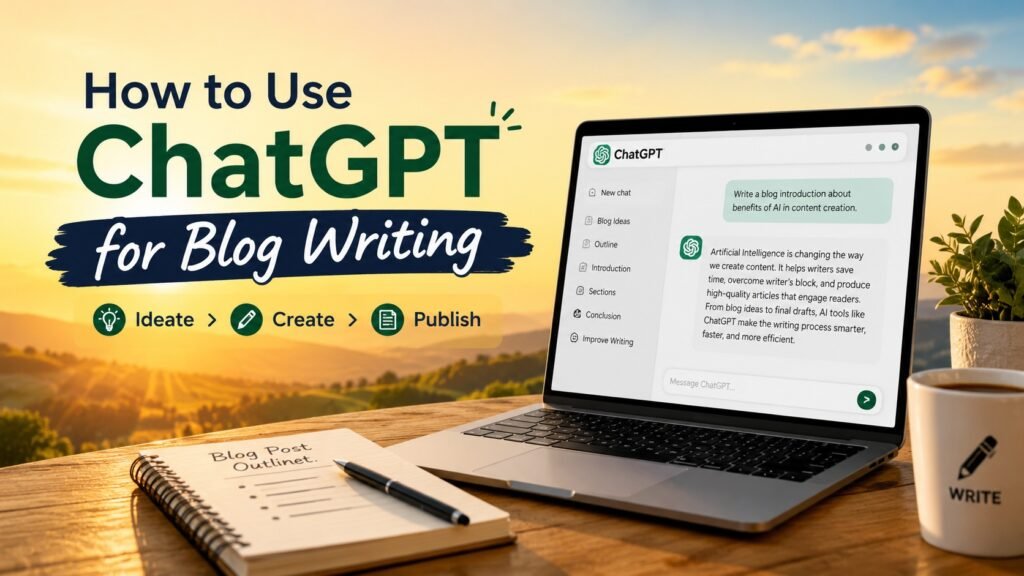
ChatGPT can help at every stage of blog writing — but your final content should not feel like a generic AI article.
1. Create SEO Blog Structure
Prompt:
“Create a detailed SEO blog outline for ‘how to use ChatGPT for SEO’. Include H2, H3, FAQs, examples, AI Overview answer sections, and internal linking opportunities.”
A good structure should include:
- Introduction
- Quick answer
- Beginner explanation
- Benefits
- Step-by-step process
- Prompts
- Mistakes
- Expert workflow
- FAQs
- Conclusion
2. Write Better Introductions
A blog introduction should connect with the reader emotionally.
Weak intro:
ChatGPT is an AI tool that helps in SEO.
Better intro:
ChatGPT has changed how marketers research, write, and optimize content. But the real advantage is not in replacing SEO experts — it is in helping smart marketers work faster, think deeper, and build better content strategies.
3. Generate Meta Descriptions
Prompt:
“Write 10 SEO-friendly meta descriptions under 155 characters for a blog titled ‘How to Use ChatGPT for SEO’.”
Good meta description:
Learn how to use ChatGPT for SEO, keyword research, blog writing, content strategy, on-page SEO, and AI content optimization.
4. Generate FAQ Sections
Prompt:
“Create 10 FAQs for ‘how to use ChatGPT for SEO’. Each answer should be 35–50 words, beginner-friendly, and optimized for AI search.”
5. Optimize for Featured Snippets
Featured snippet-style content should answer directly.
Example:
How to use ChatGPT for SEO?
Use ChatGPT for SEO by generating keyword ideas, mapping search intent, creating blog outlines, writing meta descriptions, building content clusters, improving FAQs, and optimizing content for readability. Always verify facts, add human experience, and edit the final content before publishing.
6. Human Editing Is Mandatory
This is where many people fail.
Do not copy-paste AI output directly.
Improve the draft with:
- Real examples
- Brand voice
- Personal experience
- Data verification
- Better headings
- Updated information
- Unique opinions
- Case studies
- Local context
- Stronger CTAs
Google does not ban AI content simply because AI was used, but content created mainly to manipulate rankings or produced at scale without value can create SEO risk.
Best ChatGPT Prompts for SEO
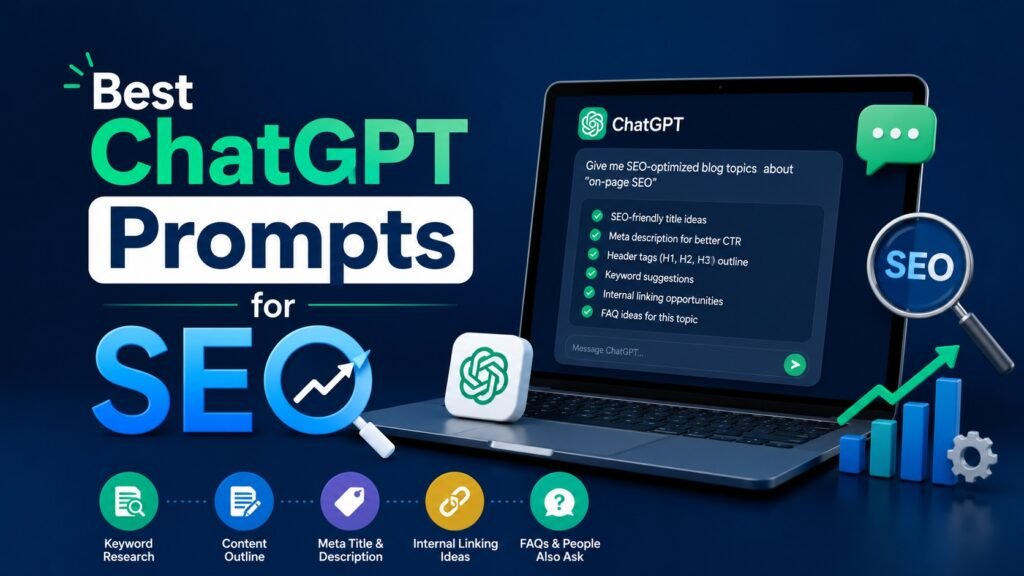
This section is the practical heart of the guide. You can copy, customize, and use these prompts.
1. Keyword Research Prompt
Act as an expert SEO strategist. Generate keyword ideas for the topic “[TOPIC]”. Divide them into seed keywords, long-tail keywords, semantic keywords, question-based keywords, and commercial keywords. Also mention search intent for each keyword.
2. Search Intent Prompt
Analyze the search intent behind these keywords: [PASTE KEYWORDS]. Classify each keyword as informational, commercial, transactional, or navigational. Suggest the best content format for each keyword.
3. Blog Outline Prompt
Create a detailed SEO blog outline for the keyword “[PRIMARY KEYWORD]”. Include H1, H2, H3 headings, direct-answer sections, FAQ ideas, internal linking opportunities, and featured snippet suggestions.
4. SEO Title Prompt
Write 15 SEO-friendly blog titles for the keyword “[KEYWORD]”. Keep them under 60 characters where possible. Make them clickable, natural, and beginner-friendly.
5. Meta Description Prompt
Write 10 meta descriptions for a blog on “[TOPIC]”. Keep each under 155 characters. Include the primary keyword naturally and make the copy click-worthy.
6. FAQ Prompt
Generate 10 FAQs for the topic “[TOPIC]”. Answers should be 35–50 words, simple, accurate, and optimized for People Also Ask, voice search, and AI search engines.
7. Internal Linking Prompt
Suggest internal linking opportunities for a blog on “[TOPIC]”. Provide anchor text, target page idea, and placement suggestion inside the article.
8. Topical Authority Prompt
Build a topical authority map for “[NICHE]”. Include pillar pages, supporting blogs, comparison articles, beginner guides, advanced guides, and FAQs.
9. Content Optimization Prompt
Review this blog draft for SEO improvement. Suggest changes for search intent, headings, semantic keywords, readability, EEAT, internal linking, and featured snippet optimization: [PASTE CONTENT].
10. AI Overview Optimization Prompt
Optimize this content for Google AI Overview-style extraction. Add concise answers, clear definitions, bullet points, comparison sections, FAQs, and entity-rich explanations without keyword stuffing.
11. Humanization Prompt
Rewrite this AI-generated paragraph in a natural human tone. Make it sound like an experienced SEO mentor explaining to beginners. Avoid robotic words and add practical examples.
12. Content Gap Prompt
Compare these competitor headings with my blog outline. Identify missing subtopics, FAQs, examples, and content gaps. Suggest how to make my article more helpful and practical: [PASTE DATA].
How to Use ChatGPT for On-Page SEO
On-page SEO means optimizing individual pages so search engines and users can understand them better.
ChatGPT can help with many on-page SEO tasks.
1. Title Tag Optimization
A title tag should include the primary keyword and a clear benefit.
Example:
How to Use ChatGPT for SEO: Complete AI SEO Guide
Prompt:
“Write 10 title tag options for the keyword ‘how to use ChatGPT for SEO’. Keep them SEO-friendly and under 60 characters.”
2. Meta Description Optimization
Meta descriptions do not directly guarantee ranking, but they influence CTR.
Prompt:
“Write meta descriptions for this blog that are practical, clear, and CTR-focused.”
3. Heading Optimization
ChatGPT can improve H2 and H3 headings.
Weak heading:
ChatGPT SEO
Better heading:
How to Use ChatGPT for SEO Keyword Research
4. NLP and Semantic Optimization
Ask ChatGPT:
“Suggest semantic keywords and related entities that should naturally appear in a blog about ChatGPT for SEO.”
Then add them naturally inside the content.
Do not stuff keywords.
5. Internal Linking
ChatGPT can suggest internal links based on your blog topics.
Example:
In this article, you can naturally link to:
Can AI Replace Digital Marketers? when discussing whether ChatGPT can replace SEO experts.
How AI Is Changing Digital Marketing Education when discussing the future of AI learning.
AI based digital marketing course Ahmedabad when discussing practical AI SEO training.
Digital Marketing Institute in Surat when discussing ASDM’s learning ecosystem and regional digital marketing education.
6. Image Alt Text
Prompt:
“Write SEO-friendly alt text for images used in a blog about ChatGPT for SEO.”
Example:
SEO professional using ChatGPT for keyword research and content strategy
7. Schema Planning
ChatGPT can help create FAQ schema, Article schema, HowTo schema, and Breadcrumb schema.
Google says structured data helps Search understand page content and may make pages eligible for rich results, though it is not a ranking shortcut.
How to Use ChatGPT for AI Overview Optimization
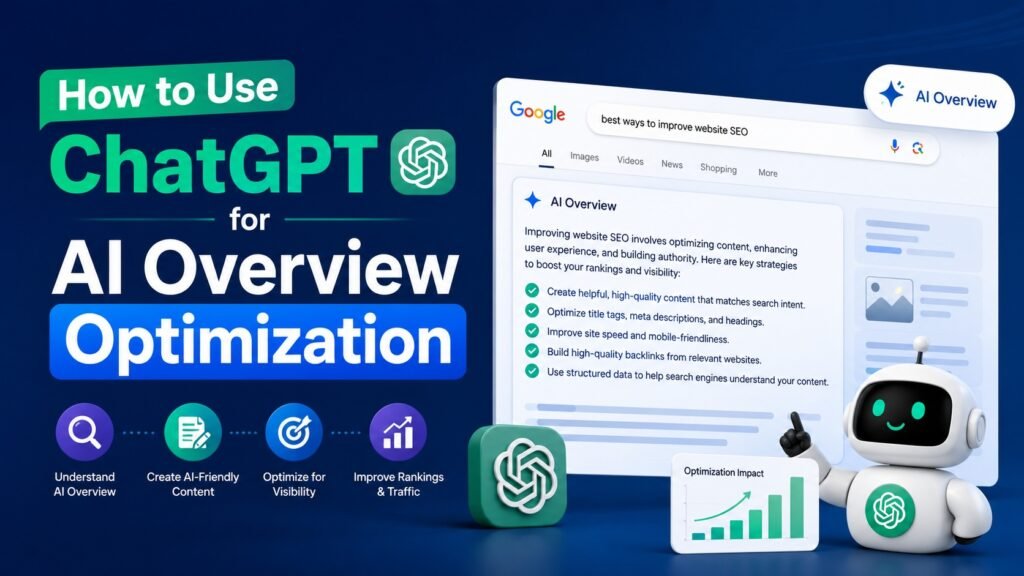
AI Overview optimization is not about tricks. It is about making your content clear, trustworthy, structured, and helpful.
Google’s official guidance says SEO remains relevant for generative AI search, and generative AI features rely on Google’s core Search ranking and quality systems. It also explains that techniques such as retrieval-augmented generation and query fan-out help AI responses gather relevant information from Search.
1. Add Direct Answer Sections
Every important H2 should start with a direct answer.
Example:
Can ChatGPT help with keyword research?
Yes, ChatGPT can help with keyword research by generating seed keywords, long-tail keywords, semantic terms, FAQ ideas, and search intent groups. However, keyword volume and competition should be verified using SEO tools.
2. Use Definition-Style Content
AI systems often extract clean definitions.
Example:
ChatGPT SEO is the process of using ChatGPT to support SEO tasks such as keyword research, content planning, blog writing, on-page optimization, FAQ creation, and content improvement.
3. Use Step-by-Step Formats
AI search engines like clean processes.
Example:
To use ChatGPT for SEO:
Choose your main keyword.
Generate related keyword ideas.
Map search intent.
Create a blog outline.
Write a first draft.
Add human examples.
Optimize title, meta, headings, and FAQs.
Fact-check and publish.
4. Add Semantic Entities
For this topic, include entities like:
ChatGPT
SEO
keyword research
content strategy
Google Search
AI Overview
EEAT
helpful content
semantic SEO
internal linking
on-page SEO
content optimization
5. Add EEAT Signals
To improve trust, include:
Author expertise
Practical examples
Real workflows
Mistake warnings
Transparent limitations
Human editing process
Updated SEO understanding
6. Avoid AI Search Myths
Do not chase fake shortcuts.
Google’s guidance says there is no special markup required for generative AI search, and website owners do not need to rewrite content only for AI systems. The focus should remain on useful, unique, valuable content and strong SEO fundamentals.
Common Mistakes People Make With ChatGPT SEO
ChatGPT is powerful, but wrong usage can damage your SEO quality.
1. Publishing AI Content Directly
This is the biggest mistake.
AI drafts often sound smooth but generic. They may miss real experience, updated facts, local context, brand voice, and unique examples.
Fix:
Use AI for first draft, then edit like a real SEO professional.
2. No Fact-Checking
ChatGPT can make confident mistakes. This is risky for industries like finance, health, law, education, and technical SEO.
Fix:
Verify important claims with trusted sources, official documentation, and real tools.
3. Keyword Stuffing
Some people ask ChatGPT to add keywords repeatedly. This makes content unnatural.
Fix:
Use semantic SEO. Add related concepts naturally.
4. Thin Content
AI can create long content that says very little.
Fix:
Add examples, screenshots, workflows, checklists, templates, case studies, and expert insights.
5. Ignoring Search Intent
A blog can fail even if it is well-written if it does not match what users want.
Fix:
Before writing, check the SERP. Understand whether Google is showing guides, tools, lists, videos, comparison pages, or product pages.
6. Overusing Generic Prompts
Bad prompt:
Write blog on SEO.
Better prompt:
Act as an SEO strategist. Write a beginner-friendly blog on how to use ChatGPT for SEO. Include keyword research, content strategy, prompts, examples, mistakes, FAQs, and human editing tips.
7. No Human Experience
Google’s helpful content guidance pushes creators to focus on people-first content. Content should demonstrate usefulness, reliability, and value beyond just search engine traffic.
Fix:
Add what you actually know from real projects, campaigns, clients, students, or website experiments.
Can ChatGPT Replace SEO Experts?

No, ChatGPT cannot fully replace SEO experts.
It can help with research, writing, ideation, optimization, and automation. But SEO still requires human strategy, business understanding, audience psychology, competitive analysis, creativity, decision-making, and experience.
ChatGPT can write a title.
But an SEO expert knows which title will match intent, improve CTR, support brand positioning, and attract the right audience.
ChatGPT can create a blog outline.
But an SEO strategist knows what the SERP demands, what competitors missed, where to add authority, what internal links matter, and how the content fits into a larger business funnel.
SEO is not only content creation.
SEO includes:
Technical SEO
Content strategy
Link building
Conversion optimization
Analytics
Brand authority
UX
Local SEO
SERP analysis
Search intent
Competitor research
So, the future is not:
AI vs SEO experts
The future is:
SEO experts using AI vs SEO experts ignoring AI
Smart marketers will use ChatGPT to save time and improve execution. Weak marketers will publish raw AI content and wonder why rankings do not improve.
Advanced ChatGPT SEO Workflow: Expert-Level Process
Here is a practical workflow you can follow for any SEO blog.
Step 1: Choose the Main Keyword
Example:
how to use ChatGPT for SEO
Check:
Search intent
SERP type
User level
Business relevance
Content depth needed
Step 2: Generate Keyword Ideas
Prompt:
“Generate seed, long-tail, semantic, and FAQ keywords for ‘how to use ChatGPT for SEO’.”
Then validate data using SEO tools.
Step 3: Analyze SERP Manually
Check top-ranking pages.
Look for:
Common headings
Content gaps
FAQ patterns
Word count range
Content format
Search intent
Examples used
Weaknesses in competitor content
Step 4: Build a Content Brief
Ask ChatGPT:
“Create a detailed SEO content brief for this keyword based on beginner search intent, practical examples, AI Overview optimization, and EEAT.”
Include:
Target audience
Primary keyword
Secondary keywords
H2/H3 structure
Key questions
Internal links
CTA
Schema
Content angle
Step 5: Create the Draft
Use ChatGPT to write section by section.
Do not ask it to write everything blindly in one prompt. Section-wise writing gives better quality.
Step 6: Add Human Experience
This is where your content becomes different.
Add:
Client examples
Student learning examples
Real SEO workflow
Mistakes you have seen
Personal observations
Better analogies
Screenshots if possible
Step 7: Optimize for EEAT
Add:
Author bio
Last updated date
Clear sources
Real examples
Transparent limitations
Practical steps
Expert tone
Step 8: Optimize On-Page SEO
Use ChatGPT for:
SEO title
Meta description
H2 improvement
FAQ expansion
Internal links
Schema generation
Summary sections
Step 9: Final Human Editing
Check:
Does it sound natural?
Is the intro strong?
Are examples practical?
Is there fluff?
Is it factually correct?
Does it answer the main query?
Is the CTA natural?
Step 10: Publish and Monitor
After publishing:
Submit URL in Google Search Console
Track impressions
Monitor CTR
Check ranking movement
Improve FAQs
Update content every few months
Add internal links from related blogs
Real-World Case Studies and Examples
These examples are realistic scenarios based on how SEO teams, bloggers, agencies, and freelancers use AI in daily workflows.
Example 1: Blogger Increasing Content Productivity
A beginner blogger wants to publish content around AI tools. Earlier, they spent 5–6 hours creating one blog outline and first draft.
With ChatGPT, the workflow becomes:
20 minutes for keyword ideas
20 minutes for outline
60–90 minutes for first draft
60 minutes for human editing
30 minutes for on-page optimization
Result:
The blogger does not just publish faster; they publish with better structure.
Example 2: Agency Scaling SEO Content
An SEO agency managing 10 clients can use ChatGPT for repetitive tasks:
Content briefs
Meta descriptions
FAQ ideas
Blog outlines
Internal linking suggestions
Content refresh plans
But the agency’s senior SEO team still handles:
Strategy
Keyword prioritization
SERP analysis
Client positioning
Quality control
Performance tracking
This saves time without compromising quality.
Example 3: Freelancer Serving Local Clients
A freelancer working with local businesses can use ChatGPT to create:
Local service page outlines
Google Business Profile post ideas
FAQ sections
Blog calendars
Location-based content ideas
Social media captions
Example prompt:
“Create a local SEO content plan for a dental clinic in Ahmedabad. Include service pages, blog topics, FAQs, Google Business Profile post ideas, and internal linking suggestions.”
This helps freelancers deliver more professional work to clients.
Future of SEO With AI
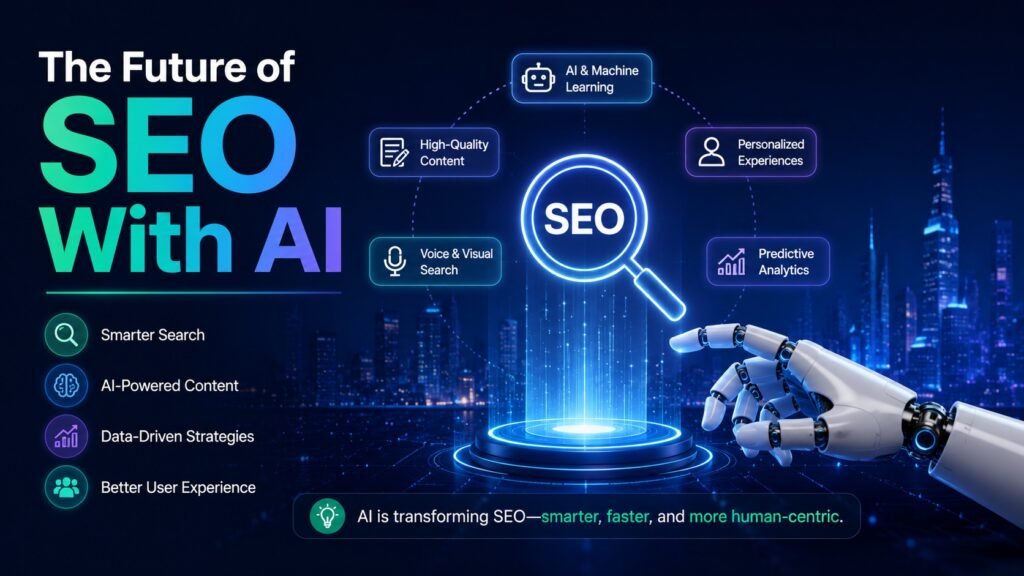
SEO is changing fast, but it is not dying.
AI is changing how people search, how Google answers, how content is discovered, and how marketers create content. Google’s guidance says SEO remains relevant for generative AI search because AI search features are rooted in core Search ranking and quality systems.
The future of SEO will be shaped by:
- AI-assisted research
- Faster content production
- Stronger EEAT signals
- More direct-answer content
- Better semantic SEO
- Human-first expertise
- Original examples
- Brand authority
- Search experience optimization
Generic content will struggle.
Practical, expert-led, experience-rich content will win.
In simple words:
AI can create content.
But humans create trust.
And trust is becoming the biggest SEO advantage.
Suggested Internal Linking Section for ASDM
To build topical authority around AI, SEO, and digital marketing education, this blog can naturally link to related ASDM content.
You can add internal links like this:
If you are serious about learning practical AI-powered marketing, explore ASDM’s AI based digital marketing course Ahmedabad, where students learn SEO, content strategy, AI tools, campaign execution, and live project implementation.
You can also read:
- Can AI Replace Digital Marketers? — to understand the future of marketing jobs in the AI era.
- How AI Is Changing Digital Marketing Education — to explore how AI is transforming learning, tools, and career skills.
- Digital Marketing Institute in Surat — if you are looking for practical digital marketing training with AI-integrated learning in Surat.
Keep these links natural. Do not over-optimize anchor text repeatedly.
Soft CTA: Learn AI-Powered SEO Practically
If you want to learn practical AI-powered SEO and content strategy, theory is not enough.
You need to learn how to:
- Research keywords
- Understand search intent
- Use ChatGPT properly
- Create SEO content briefs
- Write optimized blogs
- Build topic clusters
- Optimize for Google and AI search
- Work on live projects
- Measure real SEO performance
At ASDM, the focus is on practical digital marketing learning with AI-integrated training, live implementation, SEO workflows, content strategy, campaign execution, and real-world projects.
Because in today’s marketing world, only knowing tools is not enough.
You need to know how to think, plan, execute, optimize, and scale.
Strong Conclusion
ChatGPT is one of the most powerful tools for SEO and content strategy — but only when used correctly.
It can help you generate keyword ideas, create blog outlines, write meta descriptions, build content clusters, optimize FAQs, improve readability, and speed up your SEO workflow.
But it cannot replace human strategy.
The best SEO content still needs:
- Real expertise
- Search intent understanding
- Human editing
- Brand voice
- Original examples
- Fact-checking
- EEAT
- Practical value
So, the real question is not whether ChatGPT will replace SEO experts.
The real question is:
Will you become the kind of SEO professional who knows how to use AI better than others?
Because the future belongs to marketers who combine:
AI speed + human strategy + real execution.
That is how you use ChatGPT for SEO the right way.
FAQ Section
How to use ChatGPT for SEO?
Use ChatGPT for SEO by generating keyword ideas, mapping search intent, creating blog outlines, writing meta descriptions, building FAQ sections, improving content structure, and optimizing readability. Always fact-check outputs, add human experience, and validate keywords with SEO tools before publishing.
Can ChatGPT do keyword research?
Yes, ChatGPT can help with keyword research by generating seed keywords, long-tail keywords, semantic keywords, and FAQ ideas. However, it does not always provide accurate live search volume or keyword difficulty, so important keywords should be checked using tools like Google Keyword Planner or Search Console.
Is ChatGPT good for blogging?
ChatGPT is useful for blogging because it helps with topic ideas, outlines, introductions, headings, FAQs, summaries, and content improvement. But a blog should not be published directly from AI output. Human editing, examples, fact-checking, and original insights are necessary for quality.
Can AI replace SEO experts?
AI cannot fully replace SEO experts because SEO requires strategy, creativity, business understanding, search intent analysis, technical knowledge, and real experience. ChatGPT can support SEO work, but humans are still needed for decision-making, quality control, and long-term content strategy.
How do SEO agencies use ChatGPT?
SEO agencies use ChatGPT to create content briefs, keyword ideas, blog outlines, meta descriptions, FAQ sections, internal linking suggestions, and content refresh plans. Senior SEO professionals still handle strategy, SERP analysis, client positioning, technical SEO, and performance tracking.
Is AI content good for Google ranking?
AI content can rank if it is helpful, accurate, original, and created for users. Google focuses on content quality, not simply whether AI was used. Low-value AI content created only to manipulate rankings can violate spam policies and may perform poorly.
How to write SEO blogs using ChatGPT?
To write SEO blogs using ChatGPT, start with keyword research, map search intent, create a detailed outline, generate section-wise drafts, add examples, optimize headings, write FAQs, improve meta tags, and edit manually. The final blog should sound natural, useful, and experience-driven.
Can ChatGPT help in content strategy?
Yes, ChatGPT can help create content calendars, topic clusters, pillar page ideas, blog topics, audience segments, funnel-stage content, and internal linking plans. It is especially useful for organizing ideas and building a structured SEO content roadmap.
What are the best ChatGPT prompts for SEO?
The best ChatGPT SEO prompts are specific and role-based. Ask ChatGPT to act as an SEO strategist, analyze search intent, create keyword clusters, write blog outlines, generate FAQs, improve meta descriptions, suggest internal links, and optimize content for featured snippets and AI search.
Is AI-generated content penalized by Google?
Google does not automatically penalize content just because AI was used. The issue is quality and intent. Content created mainly to manipulate rankings or scaled without adding value may violate Google’s spam policies. Helpful, people-first content is the safer approach.