

Introduction
If you’ve recently started learning SEO, one term you’ll hear again and again is keyword density. Many beginners either ignore it completely or overuse keywords thinking it will improve rankings.
That confusion is exactly why this guide exists.
Understanding what is keyword density is important because it directly impacts how search engines interpret your content. But here’s the truth most people don’t tell you — keyword density alone doesn’t rank your page. It’s how naturally and strategically you use keywords that matters.
In fact, if you’re serious about mastering SEO, learning through a Digital Marketing Course in Ahmedabad or even exploring a Digital Marketing Course in Surat can help you understand how keyword placement works in real-world scenarios.
In this beginner-friendly guide, you’ll learn:
- What keyword density actually means
- How to calculate it
- What is the ideal percentage
- Tools you can use
- Mistakes to avoid
By the end, you’ll know how to write SEO-friendly content without sounding robotic.
What is Keyword Density?

Let’s start simple.
What is keyword density?
Keyword density is the percentage of times a specific keyword appears in your content compared to the total number of words.
Simple Definition:
It tells you how often your target keyword is used in your content.
Example:
If your article has 1000 words and your keyword appears 10 times, your keyword density is:
👉 (10 ÷ 1000) × 100 = 1%
That’s all keyword density really is — a ratio.
Why Beginners Misunderstand It
Many beginners think:
- More keywords = better ranking ❌
- Repeating keywords helps SEO ❌
But Google is smarter than that.
This is also why many students comparing Digital Marketing vs Data Science Career often misunderstand SEO fundamentals — digital marketing requires both creativity and strategic keyword usage, not just repetition.
Keyword Density in SEO Explained
Let’s understand keyword density in SEO from a practical perspective.
Search engines use keywords to understand:
- What your page is about
- Which queries it should rank for
But they don’t rely only on keyword repetition anymore.
What Google Actually Looks At:
- Context of content
- Relevance
- User intent
- Content quality
Keyword density still matters, but only as a supporting factor, not a ranking guarantee.
With the rise of automation, understanding How Artificial Intelligence Will Impact in SEO is becoming essential, as AI helps search engines better analyze context instead of just counting keywords.
Real Insight (From Experience)
I’ve seen pages rank with:
- Low keyword density but high-quality content
- Natural language and good structure
And I’ve also seen pages fail because of keyword stuffing.
Conclusion:
Keyword density helps, but content quality wins.
Keyword Density Formula (With Example)
Now let’s get practical.
Keyword Density Formula:
(Number of keyword uses ÷ Total words) × 100
Example 1:
- Total words = 1000
- Keyword used = 15 times
(15 ÷ 1000) × 100 = 1.5% keyword density
Example 2:
- Total words = 500
- Keyword used = 5 times
(5 ÷ 500) × 100 = 1% keyword density
Simple Tip:
You don’t need to calculate this every time manually — tools can do it for you.
Ideal Keyword Density for SEO
There is no official rule from Google, but based on practical experience:
Recommended Range:
- 1.5% to 2.5% → Safe and natural
What Happens If You Overuse Keywords?
- Content feels unnatural
- User experience drops
- Google may penalize
What Happens If You Underuse Keywords?
- Google may not understand your topic clearly
Best Approach:
Focus on natural writing, not numbers.
Keyword Density vs Keyword Stuffing
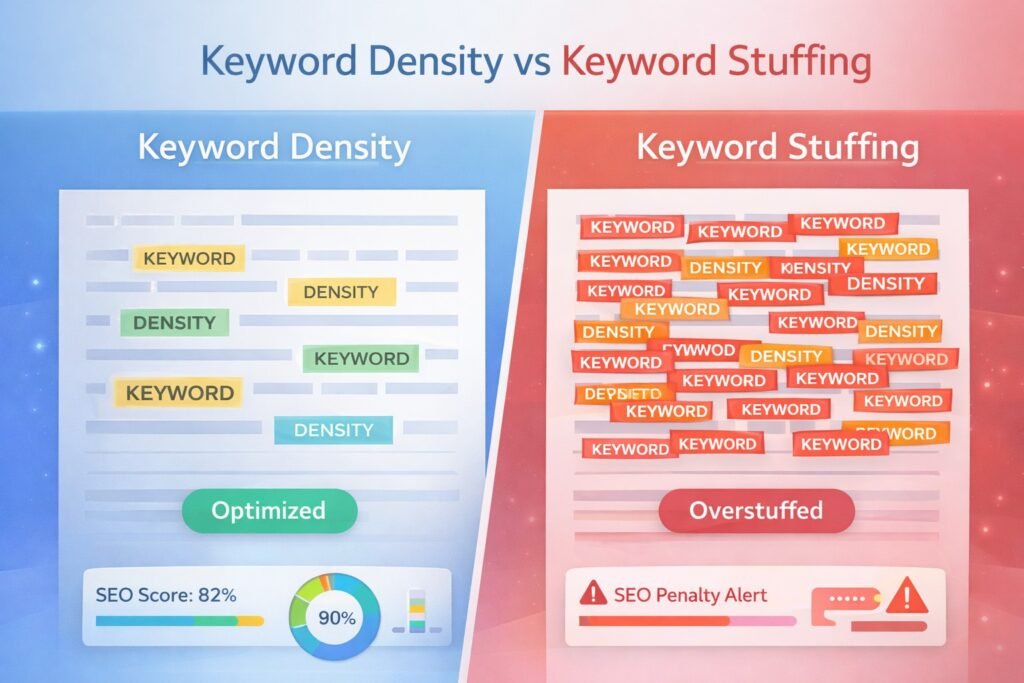
This is where most beginners go wrong.
What is Keyword Stuffing?
Overloading content with keywords to manipulate rankings.
Example (Bad):
“SEO tips for beginners are important because SEO tips for beginners help SEO tips for beginners rank better.”
Clearly unnatural.
Why It’s Dangerous:
- Google penalizes it
- Poor user experience
- High bounce rate
Difference:
Keyword Density | Keyword Stuffing |
Natural usage | Forced repetition |
Improves readability | Reduces readability |
Helps SEO | Harms SEO |
How to Check Keyword Density
You don’t need to guess.
1. Manual Method
- Count keyword usage
- Divide by total words
- Multiply by 100
2. Using Tools (Recommended)
Popular keyword density checker tools:
- Small SEO Tools
- SEO Review Tools
- Yoast SEO (WordPress)
These tools:
- Analyze keyword usage
- Highlight over-optimization
- Suggest improvements
Best Practices for Using Keywords in Content
Instead of focusing only on keyword density, follow these:
1. Use Keywords Naturally
Write like you speak.
2. Place Keywords Strategically
- Title
- Headings
- First 100 words
- Conclusion
3. Use Variations (LSI Keywords)
Example:
- keyword usage
- SEO keywords
- content optimization
4. Focus on User Intent
Ask:
What is the user trying to learn?
5. Write for Humans First
Google rewards helpful content.
Common Keyword Density Mistakes Beginners Make

1. Overusing Keywords
Trying too hard to rank.
2. Ignoring Content Quality
SEO without value doesn’t work.
3. Not Using Variations
Repeating the same keyword looks spammy.
4. Focusing Only on SEO
Forget algorithms — focus on readers.
SEO Writing Tips for Beginners
If you want to go beyond keyword density:
1. Understand Search Intent
Informational, transactional, navigational.
2. Use Structured Content
- Headings
- Bullet points
- Short paragraphs
3. Improve Readability
Simple language always wins.
4. Update Content Regularly
SEO is not one-time work.
Conclusion
Now you clearly understand what keyword density is and how it fits into modern SEO.
Here’s the key takeaway:
- Keyword density is important, but it is only a supporting factor in SEO
- It should be used naturally, not forced into content
- Overusing keywords can harm readability and rankings
- Underusing keywords may reduce content clarity for search engines
- Natural writing always performs better than keyword stuffing
If you focus on:
- Creating high-quality and valuable content
- Understanding and matching user intent
- Placing keywords strategically in titles, headings, and key sections
- Using variations and related keywords instead of repetition
- Maintaining readability and user engagement
You’ll rank better than most beginners and build long-term SEO success.
FAQ Section
What is the ideal keyword density for SEO?
There is no fixed keyword density officially recommended by Google, but a safe and practical range is between 0.5% to 1.5%. The main goal is to maintain natural readability while ensuring your keyword appears enough for search engines to understand the topic. Overusing keywords can make content look spammy and harm rankings, while too few may reduce clarity. Always focus on delivering meaningful, high-quality content rather than strictly following percentages.
Does keyword density affect Google rankings?
Keyword density does have some influence on rankings, but it is not a primary ranking factor. Google focuses more on content quality, relevance, and user intent. Proper keyword usage helps search engines understand your topic, but excessive repetition can lead to over-optimization issues. Instead of focusing only on keyword frequency, prioritize creating helpful, informative content that satisfies user queries and maintains a natural flow.
What is keyword stuffing in SEO?
Keyword stuffing is the practice of overloading content with keywords in an attempt to manipulate search engine rankings. This results in unnatural, repetitive, and difficult-to-read content. Google penalizes such practices because they negatively impact user experience. Instead of forcing keywords, they should be used naturally within the content. High-quality writing that provides value to users is always more effective than excessive keyword repetition.
How can I check keyword density?
You can check keyword density manually by dividing the number of times a keyword appears by the total word count and multiplying by 100. However, using SEO tools is much easier and more accurate. These tools analyze keyword frequency, highlight overuse, and provide suggestions for improvement. They help maintain a balance between optimization and readability, ensuring your content remains user-friendly while still being SEO-optimized.
Is keyword density still important in 2026?
Keyword density is still relevant in 2026, but its importance has decreased significantly. Modern SEO focuses more on context, semantic understanding, and user intent. Search engines now use advanced AI to interpret content meaning rather than relying on keyword repetition. While keywords are still necessary, natural language, content quality, and user-focused writing play a much bigger role in achieving higher rankings.
How does AI impact keyword usage in SEO?
Artificial Intelligence has transformed keyword usage in SEO by prioritizing context and intent over exact keyword matches. Search engines can now understand synonyms, related terms, and user behavior patterns. This reduces the importance of keyword density and encourages content creators to write naturally. AI helps search engines evaluate content quality, making it essential to focus on delivering valuable, relevant, and well-structured information.
What are LSI keywords and why are they important?
LSI (Latent Semantic Indexing) keywords are related terms that support your main keyword and help search engines understand the context of your content. They improve relevance by connecting your topic with related concepts. Using LSI keywords prevents keyword repetition, enhances readability, and increases your chances of ranking for multiple search queries. They play an important role in modern SEO strategies focused on semantic search.
How to use keywords naturally in content?
To use keywords naturally, include them in important areas like headings, introductions, and key sections without forcing them. Focus on writing for users first, ensuring your content is clear and helpful. Use variations and related terms instead of repeating the same keyword multiple times. This improves readability, keeps the content engaging, and helps search engines understand the overall context more effectively.
Can I rank without focusing on keyword density?
Yes, it is possible to rank without strictly focusing on keyword density. Modern SEO prioritizes high-quality content, user intent, and proper structure. If your content answers user queries effectively and provides real value, it can rank well even with low keyword density. Natural keyword usage combined with strong content and readability is more effective than focusing only on keyword percentages.
How many times should I use a keyword in an article?
There is no fixed number for keyword usage in an article. It depends on the content length, topic, and context. Instead of counting how many times a keyword appears, focus on placing it naturally in key areas like headings, introduction, and conclusion. Using variations and related keywords helps maintain readability while ensuring search engines clearly understand your content topic.