For years, digital advertising has largely revolved around two questions:
What is the customer searching for?
and
Which audience should we show the ad to?
Google Ads built an enormous advertising ecosystem around search intent and keywords. Meta Ads built another around audience signals, interests, behaviours and content consumption.
Now there is a different environment emerging: conversational advertising.
People increasingly use ChatGPT to research products, compare software, understand services, solve problems, plan projects and decide what to do next. Instead of typing a short search query, they may explain an entire problem in a sentence—or several paragraphs.
That creates a fundamentally different advertising opportunity.
ChatGPT Ads in India are now available through OpenAI’s self-serve Ads Manager, giving eligible Indian businesses another paid acquisition channel to test. OpenAI announced the India expansion in August 2026 as part of the global expansion of ChatGPT Ads. The company said the advertising platform had reached a $1 billion annualized revenue run rate and was being used by tens of thousands of advertisers at that point.
But launching a ChatGPT advertising campaign is not simply a matter of taking an existing Google Ads campaign, replacing “Google” with “ChatGPT,” and pressing Publish.
The advertising environment is different.
The way relevance is determined is different.
The way advertisers think about targeting is different.
And the creative strategy can be different.
This guide explains ChatGPT Ads in India from a performance-marketing perspective, including how ChatGPT advertising works, current pricing, targeting, campaign structure, context hints, tracking, measurement, real-world advertiser case studies, common mistakes and a practical framework for launching your first campaign.
What Are ChatGPT Ads?
ChatGPT Ads are sponsored advertisements displayed within the ChatGPT experience.
They are designed to appear alongside relevant conversations while users are exploring a topic, comparing options or trying to accomplish a particular task.
The important word here is sponsored.
An advertisement is not the same thing as ChatGPT’s organic response.
OpenAI says ads are clearly labeled and remain separate from ChatGPT’s answers. Advertising does not influence the answers generated by ChatGPT, and advertisers do not receive access to users’ private conversations.
This distinction is important because conversational advertising could otherwise create confusion between:
What ChatGPT recommends organically
and
What an advertiser has paid to promote.
ChatGPT’s current ad format can include the advertiser name, favicon or logo, headline, description, landing page and image creative. Ads appear below ChatGPT responses rather than being presented as part of the model’s answer.
Why is this different from traditional advertising?
Consider a normal Google search.
A person might type:
best CRM for small business
Google returns search results and ads around that query.
Now consider a ChatGPT conversation:
“I run a small sales team of six people. We currently track leads in spreadsheets, but follow-ups are getting missed. What should I look for in a CRM?”
That is not just a keyword.
It contains:
- The business situation
- The problem
- The size of the team
- The current solution
- The desired outcome
- The user’s intent
This is the environment in which ChatGPT advertising becomes interesting.
The advertiser isn’t simply trying to match the words “CRM software.”
The advertiser wants to be relevant when a potential customer is experiencing a situation that the product can solve.
A simple example
Imagine an online education company.
A traditional search campaign might target:
- digital marketing course
- digital marketing course Ahmedabad
- SEO course
- PPC course
- digital marketing institute
A conversational advertising approach could instead be relevant to a situation like:
“I have completed graduation and want to learn digital marketing, but I don’t know which skills I should learn first.”
That conversation contains considerably more information about the user’s problem.
This is one of the key ideas marketers need to understand before creating ChatGPT Ads for businesses.
How Does Advertising on ChatGPT Work?
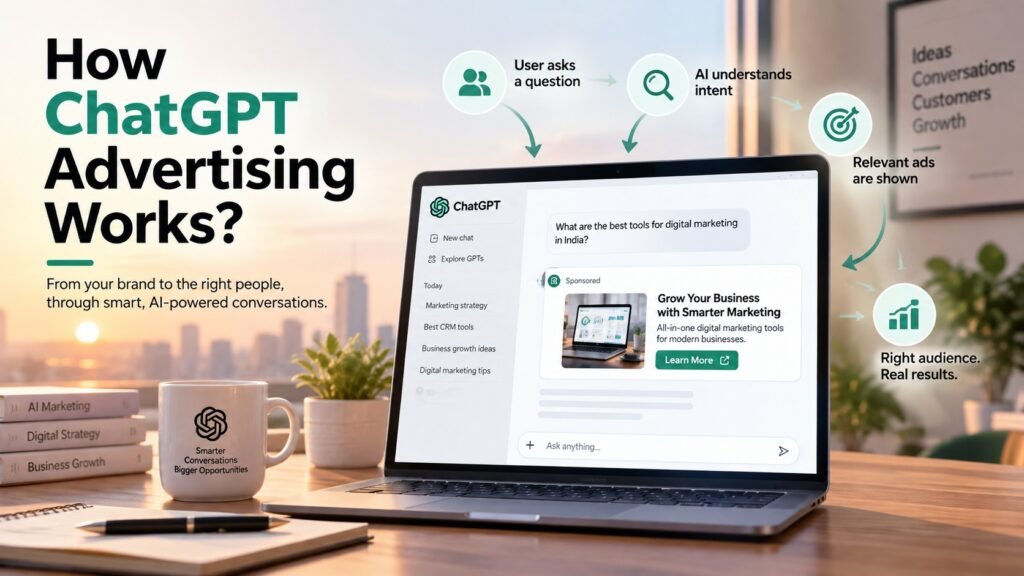
The easiest way to understand advertising on ChatGPT is to forget the idea that it works exactly like a keyword search engine.
OpenAI says its ad system considers multiple relevance signals, including:
- The current conversation context
- User intent
- The advertisement
- The ad’s title
- Ad copy
- The landing page
- Advertiser-provided context hints
- And, when ads personalization is enabled, selected signals from the user’s broader ChatGPT experience
That means relevance is determined using more than one input.
Conversation context matters
Suppose someone is discussing:
“I need to create an online store for my clothing business. I don’t have technical knowledge and want something I can manage myself.”
A business offering an e-commerce platform may have a natural opportunity to appear in that context.
But another business selling unrelated software would have little reason to be relevant.
The system is designed to consider that contextual relationship.
The landing page also matters
This is an important difference from the way many inexperienced advertisers approach paid media.
Your advertisement cannot be considered independently from your website.
Suppose your ad says:
Build Your First Online Store
But clicking the ad takes the visitor to a generic company homepage with no information about e-commerce.
There is a disconnect.
Now imagine the ad leads to:
Create Your Online Store — Beginner-Friendly E-commerce Platform
The second experience continues the same conversation.
That creates a more logical path:
Conversation → Ad → Landing Page → Action
Context hints add another layer
Advertisers can provide context hints at the ad-group level.
These hints help the system understand when the advertiser’s offering may be relevant.
OpenAI specifically explains that context hints are not exact-match keywords or targeting rules. They guide relevance but do not guarantee that an ad will appear in a particular conversation.
This is one of the most important concepts in ChatGPT Ads targeting.
How Much Do ChatGPT Ads Cost in India?

There is no single fixed ChatGPT Ads cost that every Indian advertiser will pay.
Your cost depends on the campaign objective, bidding, competition, delivery, relevance, creative and other campaign factors.
However, there is a current minimum budget requirement worth knowing.
For an account billed in INR, OpenAI currently lists a minimum daily campaign budget of ₹725.
That does not mean:
“ChatGPT Ads cost ₹725 per day.”
It means ₹725 is currently the minimum daily campaign budget listed for INR accounts.
Your actual spend and results depend on your campaign setup.
ChatGPT Ads pricing models
OpenAI currently supports advertising approaches built around different objectives.
1. Views
A Views objective is designed around impression-based advertising.
This is the environment where CPM—cost per 1,000 impressions—becomes an important metric.
For example:
If a campaign spends ₹1,000 and generates 20,000 impressions:
CPM = ₹50
That does not automatically mean the campaign is successful.
You still need to understand what happened after those impressions.
2. Clicks
A Clicks objective is designed to drive traffic.
This makes CPC—cost per click—an important metric.
For example:
If you spend ₹2,000 and generate 100 valid clicks:
CPC = ₹20
But again, ₹20 CPC isn’t automatically good or bad.
If those 100 clicks generate 20 qualified leads, the campaign may be commercially useful.
If they generate zero meaningful actions, even a low CPC may be wasteful.
3. Conversions
Conversion-oriented campaigns focus on a supported conversion event rather than simply maximizing traffic.
This is particularly important for performance marketers.
Suppose a company sells a SaaS subscription.
Getting:
10,000 impressions
sounds impressive.
Getting:
500 clicks
sounds better.
But if only:
2 people sign up
the campaign needs attention.
The real business metric may be:
Cost per signup
or:
Cost per qualified customer.
OpenAI’s current Ads Manager documentation supports Views, Clicks and Conversions objectives.
What should an Indian advertiser budget?
There is no universal answer.
A small business might begin with the minimum viable test budget.
A larger SaaS company may need substantially more data before making a channel decision.
A useful principle is:
Do not choose a budget because someone says “₹X is the perfect ChatGPT Ads budget.” Choose it based on your testing objective, expected conversion economics and the amount of data you need to make a decision.
OpenAI also cautions that ChatGPT Ads is still in beta and does not yet have broad performance benchmarks across industries and campaign types.
Who Sees Your Ads, and Who Does Not?
Before spending money, you need to understand the available audience.
ChatGPT Ads are not shown to every ChatGPT user.
OpenAI’s current documentation says ads are not shown to users on Plus or Pro, Business plans, or accounts identified as belonging to people under 18. The advertising-supported experience is therefore concentrated among eligible users rather than the entire ChatGPT user base.
OpenAI’s advertising policies also restrict ad placement around sensitive or brand-unsafe conversations.
These include contexts involving areas such as:
- Political content
- Weapons
- Gambling
- Tobacco
- Fraud or deception
- Graphic violence
- Hate or harassment
- Illicit content
- Certain sexual content
- Child safety
- Suicide and self-harm
- Sensitive personal or mental-health contexts
- Other vulnerable-user situations
Why does this matter to advertisers?
Imagine a healthcare-related business.
It might think:
“Someone discussing a health problem is highly relevant to my service.”
From a normal advertising perspective, that might seem logical.
But advertising policy is not based only on commercial relevance.
Sensitive contexts may be protected specifically because advertising there could undermine user trust.
Therefore:
Relevant conversation ≠ automatically eligible advertising environment.
That is an important distinction for ChatGPT Ads eligibility.
ChatGPT Ads Targeting Works Nothing Like Google Ads
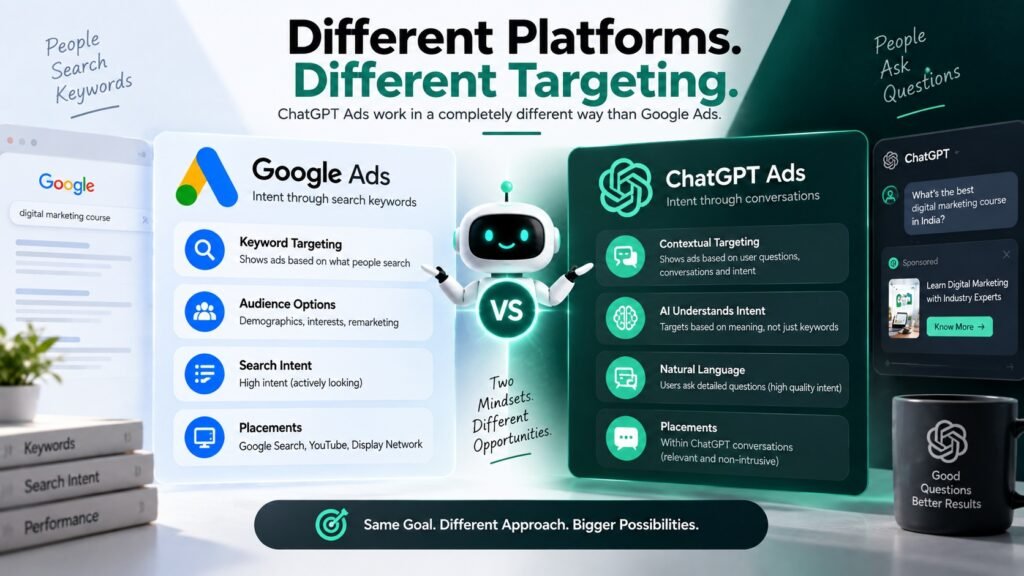
This is probably the most important section for anyone coming from Google Ads.
If you have managed Google Ads for years, your natural instinct may be:
“Give me the keyword list.”
But that is not the right starting point for ChatGPT Ads.
Google Ads starts with a search query
A user searches:
A marketer may target that query through relevant keyword strategies.
ChatGPT works differently.
The user may instead say:
“I’m in Ahmedabad and have just finished graduation. I want to learn digital marketing because I’m interested in SEO and paid advertising. What should I learn first?”
That is an entire situation.
There may not be one exact keyword representing it.
Think about three questions
When creating a ChatGPT Ads campaign, ask:
What do I sell?
Who needs it?
When would they need it?
This produces a much stronger basis for context.
What Are Context Hints in ChatGPT Ads?
Context hints are additional descriptions that help ChatGPT’s advertising system understand when your product or service may be relevant.
OpenAI recommends writing specific phrases describing what you offer, who it helps or when it may be useful.
Weak context hint
Digital marketing course
This tells the system very little.
Better context hint
Practical digital marketing training for students and working professionals who want to learn SEO, paid advertising, social media marketing and analytics.
Now we understand:
- The product
- The audience
- The use case
- The subject area
Even more specific
Structured digital marketing training for beginners, graduates and working professionals who are exploring a career in digital marketing and want practical exposure to SEO, Google Ads, Meta Ads, analytics and related tools.
This gives considerably more context.
But remember:
A context hint is not a keyword list.
It is not:
SEO course, PPC course, digital marketing course, digital marketing institute, SEO training
OpenAI explicitly says context hints inform relevance but do not function as exact-match keywords or guaranteed targeting rules.
Geographic Targeting: Can You Target Ahmedabad?
This is an especially important question for local Indian businesses.
If your business serves Ahmedabad, you may naturally want to target:
Ahmedabad
rather than all of India.
OpenAI’s campaign documentation says advertisers can use supported geographic targeting such as countries and, for applicable campaigns, locations including states or regions, cities, markets and postal codes. Availability varies by country and campaign.
That means geographic targeting should be configured through the campaign’s available location controls.
Do not try to use a context hint as a substitute.
For example:
“People in Ahmedabad looking for a digital marketing course.”
This may provide contextual information, but it does not turn the hint into a hard geographic targeting rule.
ChatGPT Ads Campaign Structure and Pricing
A well-structured ChatGPT Ads campaign normally has three important levels:
Campaign
↓
Ad Group
↓
Ads
Each level has a different job.
Campaign
The campaign represents the broader business objective.
Depending on the available setup, campaign-level configuration can include:
- Campaign name
- Objective
- Budget
- Start date
- End date
- Countries/locations
- Platforms where applicable
- Conversion event where relevant
- Other supported targeting settings
Example
For ASDM:
Campaign: Digital Marketing Course — Lead Generation
The campaign should have one clear commercial purpose.
Ad Groups
Ad groups should be organized around a shared product, service, theme or customer need.
OpenAI recommends separating meaningfully different use cases when they require different messaging or landing pages.
For ASDM, you might create:
Ad Group 1: Career Change
Audience situation:
People considering digital marketing as a career.
Landing page:
Career-oriented digital marketing course.
Ad Group 2: Beginners
Audience situation:
Students or beginners looking for structured digital marketing education.
Landing page:
Beginner-focused course page.
Ad Group 3: SEO Learning
Audience situation:
People specifically trying to build practical SEO skills.
Landing page:
SEO-focused course information.
Ad Group 4: Performance Marketing
Audience situation:
People interested in Google Ads, Meta Ads and measurable acquisition.
Landing page:
Performance-marketing-focused content.
The advantage is simple.
You can make the message, context and landing page match the customer’s situation.
Measurement Is More Mature Than You Might Expect
One common assumption is that ChatGPT Ads is too new to measure properly.
That is not accurate.
OpenAI’s current advertising documentation includes reporting and measurement capabilities around metrics such as impressions, clicks, spend and performance, while Ads Manager Beta also supports conversion measurement and CPC bidding.
But the important lesson is not simply:
“Look at CPC.”
A performance marketer needs to build a complete funnel.
Level 1 — Delivery
Track:
- Impressions
- Spend
- CPM
- Delivery
This tells you whether the campaign is actually getting opportunities to show.
Level 2 — Engagement
Track:
- Clicks
- CTR
- CPC
These tell you whether users are responding to the advertising.
Level 3 — Website behaviour
Once the visitor reaches your site, measure:
- Landing-page engagement
- Form starts
- Product views
- Signup starts
- Checkout starts
- Time or engagement indicators where meaningful
Level 4 — Business outcomes
Ultimately measure:
- Leads
- Qualified leads
- Sales
- Revenue
- Cost per lead
- Cost per acquisition
- ROAS
- Customer quality
This is where ChatGPT Ads analytics becomes genuinely useful.
Real ChatGPT Ads Case Study: Stream
One of the most useful documented examples comes from Stream, a company providing real-time communication APIs and SDKs.
Stream had historically relied heavily on content marketing and paid search.
But the company noticed something changing in developer behaviour.
Developers were increasingly using AI assistants to work through technical problems.
Instead of searching only short keywords, developers were asking detailed questions such as how to add chat to an application, build video calling or choose infrastructure for a particular product requirement.
That created a natural fit for conversational advertising.
What did Stream do?
Rather than creating a generic awareness message, Stream designed campaigns around the actual problems developers were trying to solve.
The company’s approach was essentially:
Developer problem → Relevant context → Specific solution → Start building
This is a useful lesson for any B2B marketer.
Don’t advertise only:
“We provide communication APIs.”
Instead, think:
“A developer is trying to add real-time chat to an application.”
The second situation is much closer to an actual buying/use case.
Results
In a test conducted from June 5 through August 5, 2026, Stream compared ChatGPT Ads with other channels using comparable media spend.
According to Stream’s published case study:
- More than 70% of ChatGPT Ads clicks became website sessions.
- The comparable tested channels were below 10% on that measure.
- Stream reported approximately 2× ROAS from its developer-skills campaign.
- The test used approximately $10,000 in media spend per test group.
These are Stream’s own reported results, not a universal benchmark for ChatGPT Ads.
What can Indian marketers learn?
The most useful lesson isn’t the 2× ROAS figure.
The deeper lesson is the alignment between intent and creative.
Stream didn’t simply say:
“We are a developer platform.”
It focused on problems developers were actively trying to solve.
For an Indian SaaS company, this could mean creating campaigns around specific customer problems rather than broad category descriptions.
Real ChatGPT Ads Case Study: Jotform
Jotform provides another valuable example because its product covers many different use cases.
Jotform is used for things such as:
- Lead collection
- Registration
- Payments
- Agreements
- Approvals
- Workflow automation
That creates a marketing challenge.
A single generic advertisement may not explain why the product is relevant to every user.
The use-case approach
Jotform experimented with campaigns around different use cases rather than treating every potential customer identically.
According to Jotform’s published case study, the company improved performance through several iterations.
Among the reported improvements:
- Optimizing landing pages for use-case campaigns increased signup rate by 2.5×.
- Moving from reach campaigns to click campaigns reduced cost per click by 4–5× without sacrificing acquisition quality.
- Expanding and refining creative increased CTR by 65%.
- More than 10% of ChatGPT Ads clicks converted into signups.
- Cost per signup was approximately 30% lower than paid search and 60% lower than paid social during the cited period.
Again, these are Jotform’s reported results and should not be treated as guaranteed performance for another advertiser.
The most important lesson
The strongest takeaway may actually be the landing-page result.
A user sees an ad about a specific problem.
They click.
If the landing page immediately continues that same use case, conversion can improve.
This creates:
Intent → Ad relevance → Landing-page relevance → Conversion
For Indian advertisers, this is a powerful principle regardless of the advertising platform.
Real ChatGPT Ads Case Study: LegalNature
LegalNature provides another interesting example because its service solves highly specific problems.
The company helps consumers and businesses create legal documents online.
Someone may need:
- A power of attorney
- A quitclaim deed
- An LLC document
- Another specific legal document
This is different from a broad consumer product where the buyer may browse casually.
The customer often arrives with a defined task.
Why ChatGPT was interesting for LegalNature
LegalNature had historically relied heavily on search advertising because users often already knew what document they needed.
ChatGPT introduced another possibility:
A person might first explain their situation conversationally, clarify what they need and then click through to a service that can help them complete the actual task.
According to LegalNature’s September 2026 case study:
- Around 40% of ChatGPT Ads visitors started the document-creation flow immediately after arriving.
- Around 8% of all ChatGPT Ads visitors completed an entire guided legal document.
- Around 95% of completed documents were finished within one hour of arrival.
- Approximately 71% of users who completed a document submitted their email to create a free account.
The company says these figures came from its internal analytics warehouse using last-click attribution for ChatGPT Ads traffic from July 1 through August 23, 2026.
Why this case study matters
LegalNature demonstrates an important concept:
Conversational discovery can potentially shorten the distance between a user’s question and a clearly defined task.
But that does not mean every advertiser will achieve an 8% completion rate.
The product itself matters.
The landing page matters.
The customer intent matters.
The funnel matters.
The case study should therefore be treated as evidence of what one advertiser achieved—not as a ChatGPT Ads benchmark.
What These Three Case Studies Tell Us
Stream, Jotform and LegalNature operate in different industries.
Yet their approaches have something in common.
Stream
Focused on specific developer problems.
Jotform
Focused on specific workflow use cases.
LegalNature
Focused on specific customer needs and tasks.
This suggests a useful principle for ChatGPT advertising:
Don’t start with “Who can I target?” Start with “What problem is this person trying to solve?”
That is a very different way of thinking about paid acquisition.
Which Businesses Can Advertise on ChatGPT, and Which Cannot?
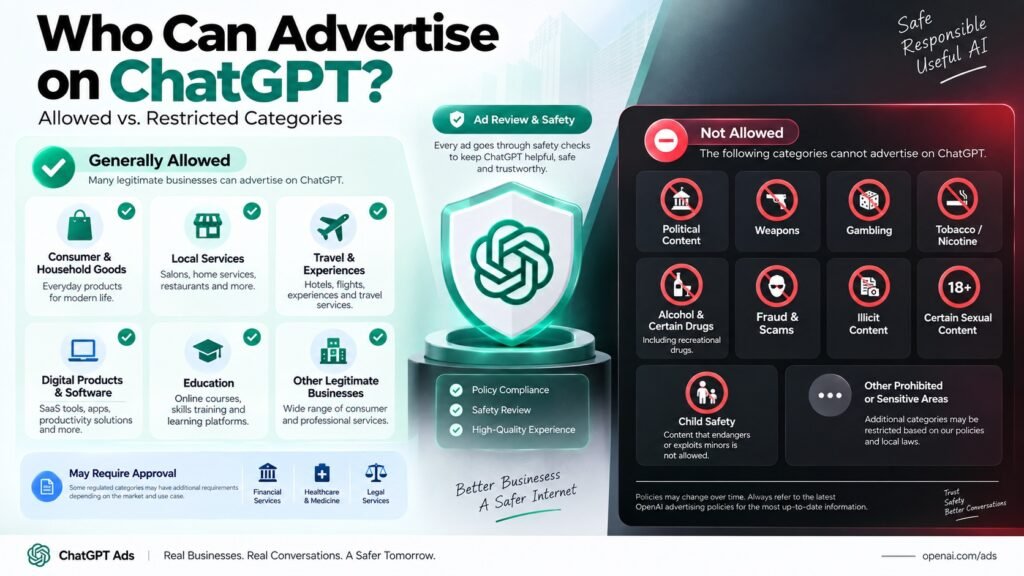
Not every business or category is automatically eligible.
OpenAI’s current advertising policies state that supported categories are being rolled out and can change.
The current policy identifies areas such as:
- Lifestyle and household products
- Local services
- Travel and experiences
- Digital products
- Education
as categories in the initial supported landscape.
Some regulated categories may be approved in particular markets and through additional review, while other categories are restricted or prohibited.
Examples of restricted or prohibited advertising contexts/categories include areas involving:
- Political content
- Weapons
- Gambling
- Tobacco
- Certain drugs/alcohol
- Fraud
- Illicit content
- Certain sexual content
- Child safety
- Other prohibited or sensitive areas
Important distinction
There are two different questions:
Is my business category potentially supported?
and
Will my particular advertisement be approved?
The second question can depend on:
- The product
- The ad copy
- Creative
- Landing page
- Market
- Policy requirements
- Review
OpenAI also says the standards apply across the advertising experience, including ad assets and landing pages.
How ChatGPT Ads Compare With Google Ads and Meta Ads
It is tempting to ask:
“Which platform is better?”
That is not the most useful question.
The more useful question is:
“What kind of customer behaviour does each platform help me capture?”
| Factor | ChatGPT Ads | Google Ads | Meta Ads |
|---|---|---|---|
| Core environment | AI conversation | Search ecosystem | Social/content ecosystem |
| User behaviour | Researching, comparing, solving | Searching | Browsing/discovering |
| Major relevance signal | Conversation/context | Search intent and other signals | Audience/platform signals |
| Keyword-led | No | Strongly relevant to many campaigns | Not primarily |
| Context hints | Yes | No direct equivalent | No direct equivalent |
| CPC | Supported | Supported | Supported |
| CPM | Supported | Depends on campaign | Supported |
| Conversion optimization | Supported | Supported | Supported |
| Landing-page relevance | Important | Important | Important |
| Platform maturity | Newer/beta | Mature | Mature |
OpenAI currently describes ChatGPT Ads as being in beta and early scaling, so marketers should be cautious about treating it as equally mature to established platforms.
Google Ads
Google is particularly useful when the customer already knows what they are looking for.
Example:
“digital marketing course Ahmedabad”
There is explicit search intent.
Meta Ads
Meta can be powerful for discovery, content-led demand generation and audience-based campaigns.
Someone may not be actively searching for your product.
Your advertisement introduces the product or problem.
ChatGPT Ads
ChatGPT sits in a different environment.
A user may already be discussing:
“How can I start a career in digital marketing?”
“What should I learn to become a performance marketer?”
The advertising opportunity can emerge within that conversation.
The platforms therefore don’t have to be treated as mutually exclusive.
How to Launch Your First ChatGPT Ads Campaign
Now let’s turn this into an actionable process.
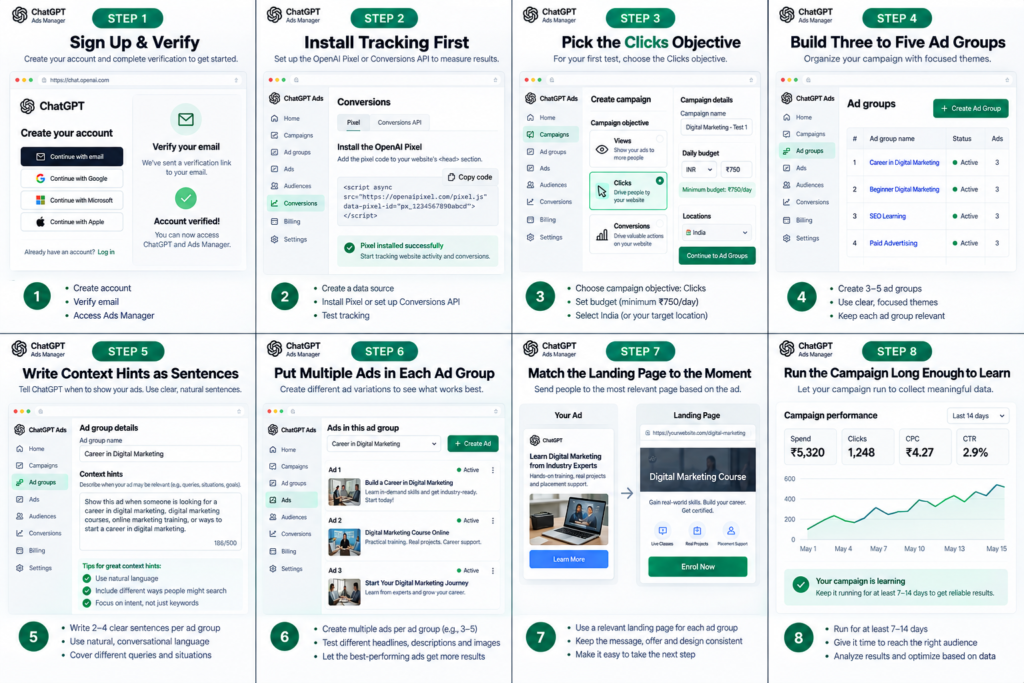
Step 1: Sign Up and Verify
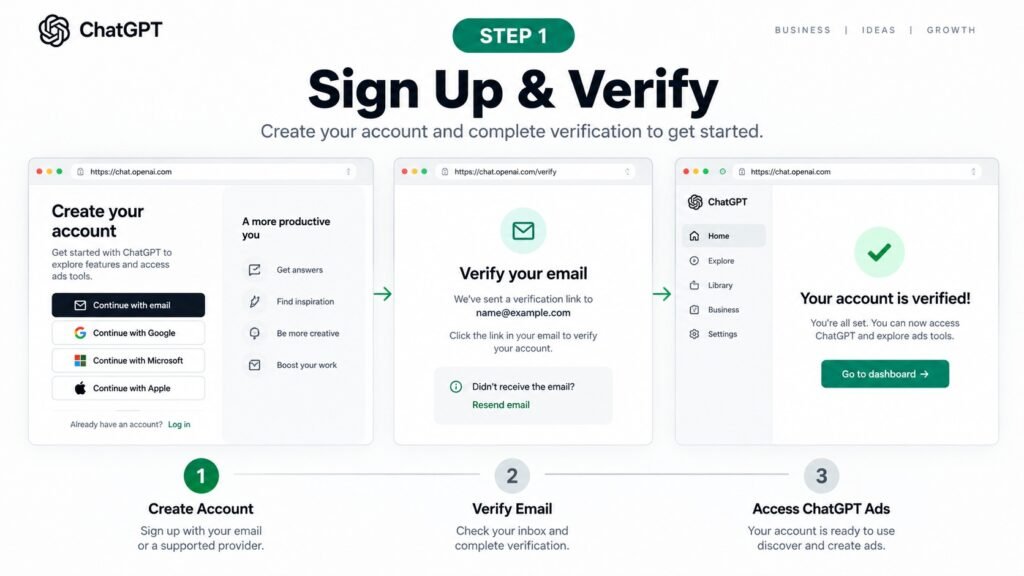
India is currently part of the self-serve ChatGPT Ads rollout.
OpenAI announced that advertisers in India could purchase ChatGPT Ads directly through Ads Manager as part of the August 2026 global expansion.
Before launching:
- Create/access your Ads Manager account.
- Complete account verification.
- Set up billing.
- Confirm your business details.
- Check whether your category is eligible.
- Review advertising policies.
Don’t build a large campaign before confirming that the account can actually advertise.
Step 2: Install Tracking First
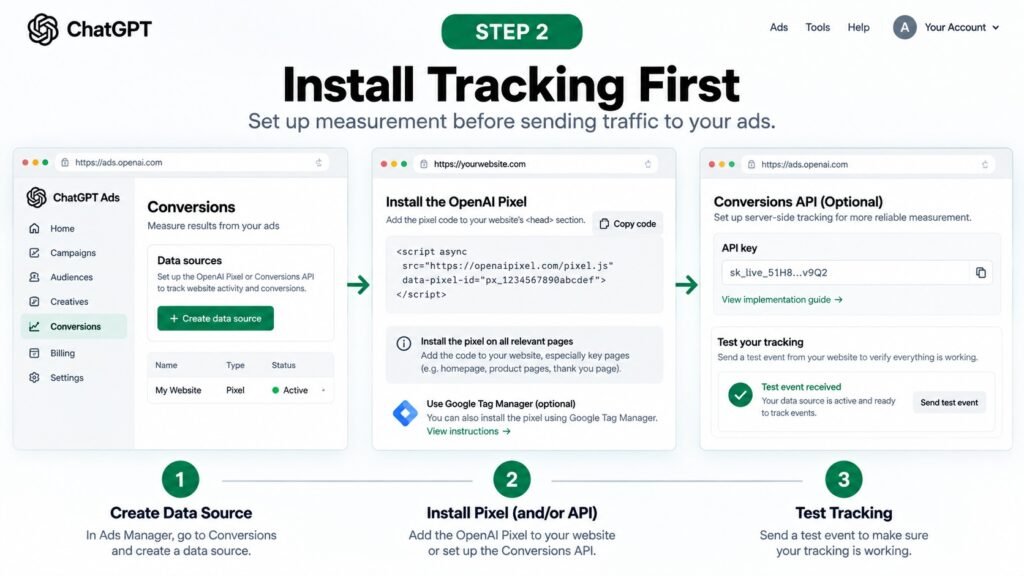
This is one of the biggest rules of performance marketing:
Do not launch first and think about measurement later.
Before spending:
- Configure conversion measurement where appropriate.
- Add UTM parameters.
- Confirm that your analytics platform receives traffic correctly.
- Test forms.
- Test purchase events.
- Test lead events.
- Confirm that the landing page loads correctly.
Example UTM
A simple structure could be:
utm_source=chatgpt
utm_medium=paid
utm_campaign=dm_course
utm_content=career_ad
Your exact naming system can be different.
The important thing is consistency.
Step 3: Pick the Clicks Objective for Your First Test
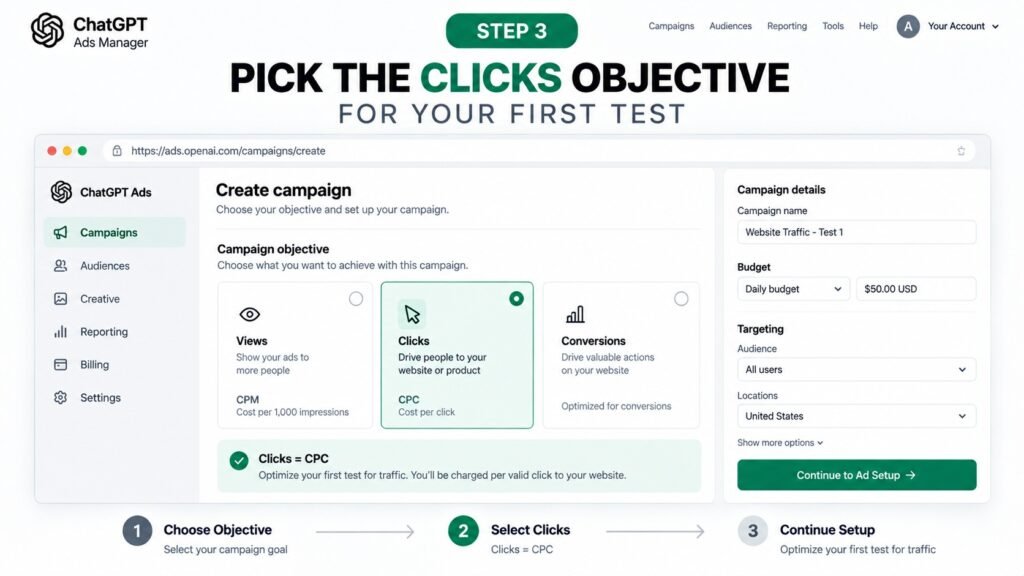
For a new advertiser whose immediate goal is to understand traffic quality, a Clicks objective can be a straightforward starting point.
But this is not a universal rule.
If your website already has reliable conversion tracking and you have a clear supported conversion event, a conversion-oriented campaign may make more sense.
The correct objective is the one that matches the business goal.
Don’t select Clicks simply because CPC is easier to understand.
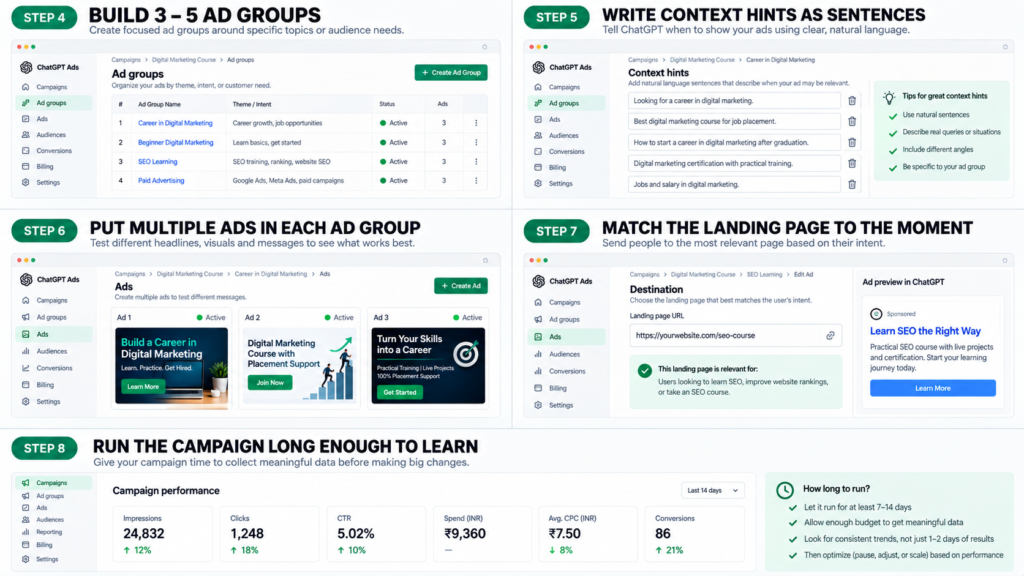
Step 4: Build Three to Five Ad Groups
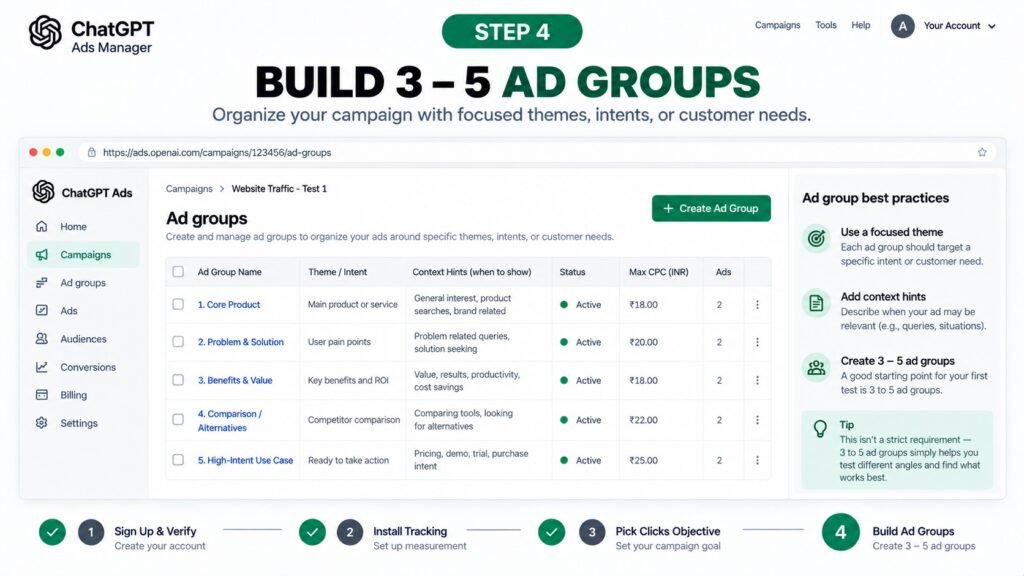
Don’t build one giant ad group containing every possible customer.
Start with distinct customer situations.
For ASDM, for example:
Ad Group 1 — Career in Digital Marketing
Context: Graduates and working professionals exploring digital marketing as a career and looking for structured practical training.
Ad Group 2 — Beginner Digital Marketing
Context: Students and beginners looking for a structured way to understand digital marketing fundamentals and practical tools.
Ad Group 3 — SEO Learning
Context: People trying to develop practical SEO skills including keyword research, technical SEO, content optimization and search performance analysis.
Ad Group 4 — Paid Advertising
Context: Learners and marketers looking to understand Google Ads, Meta Ads, campaign setup, targeting, measurement and performance optimization.
Each ad group should have a reason to exist.
OpenAI recommends focused ad groups and separating materially different use cases where they need different messaging or landing pages.
Step 5: Write Context Hints as Sentences
This deserves repetition because it is so important.
Do not write:
SEO, PPC, digital marketing, Google Ads, Meta Ads
Instead: Professionals and beginners looking to learn practical digital marketing skills, including SEO, Google Ads, Meta Ads and analytics, to build their understanding through structured training.
The second version explains a situation.
OpenAI’s guidance specifically recommends clear and specific phrases that describe what the advertiser offers, who it helps and when it may be useful.
Step 6: Put Multiple Ads in Each Ad Group
Don’t create one ad and expect it to work everywhere.
Create different angles.
For example:
Ad Variation 1 — Skills
Headline: Learn Practical Digital Marketing
Description: Build practical skills across SEO, paid advertising, social media and analytics.
Ad Variation 2 — Career
Headline: Build Digital Marketing Skills
Description: Explore a structured learning path for modern digital marketing skills.
Ad Variation 3 — Beginner
Headline: Start Digital Marketing From Scratch
Description: Learn the fundamentals and move toward practical execution with structured training.
The objective isn’t to rewrite the same sentence three times.
The ads should have genuinely different angles.
OpenAI recommends diverse creative variations and says different title/copy variations should introduce different angles rather than simply repeating the same message.
Step 7: Match the Landing Page to the Moment
This may be the most overlooked part of ChatGPT Ads campaign setup.
Imagine someone is discussing:
“I’m a beginner and want to learn digital marketing.”
Your advertisement says:
Learn Digital Marketing From the Fundamentals.
Then you send the visitor to a homepage containing:
- Digital marketing course
- SEO services
- Social media services
- Web development
- Corporate training
- Contact us
- Blog
- About us
The visitor now has to search for what they originally wanted.
That creates friction.
Instead, send them to a focused page that continues the exact conversation.
Think about the funnel like this:
Conversation
↓
Relevant advertisement
↓
Relevant landing page
↓
Clear next action
This is one of the clearest lessons from the Jotform case study: OpenAI reports that optimizing landing pages around specific use cases increased signup rates by 2.5×.
Step 8: Run the Campaign Long Enough to Learn
Don’t judge a new advertising channel after a handful of clicks.
At the same time, don’t blindly follow a fixed “14-day rule.”
Your campaign needs enough data to identify meaningful patterns.
OpenAI currently describes ChatGPT Ads as a beta platform and explicitly says broad benchmarks across advertisers and industries do not yet exist. Performance can depend on objective, creative, landing page experience, relevance and overall setup.
Your first test should therefore answer questions such as:
- Which intent gets engagement?
- Which creative gets clicks?
- Which landing page converts?
- Which ad group produces qualified traffic?
- What does a lead actually cost?
- Does the traffic produce business value?
How to Measure ChatGPT Advertising Performance
A professional ChatGPT advertising strategy should not stop at CTR.
Let’s say your campaign produces:
50,000 impressions
Then:
2,000 clicks
Then:
100 leads
Then:
25 qualified leads
Then:
5 customers
Now you have a complete funnel.
A report showing only:
2,000 clicks
doesn’t tell the business enough.
Important metrics
CTR
Measures how frequently people click after seeing the advertisement.
CTR = Clicks ÷ Impressions × 100
CPC
Measures the average cost of clicks.
CPC = Spend ÷ Clicks
CPM
Measures the cost of 1,000 impressions.
CPM = Spend ÷ Impressions × 1,000
Conversion Rate
Measures how many visitors complete the desired action.
Conversion Rate = Conversions ÷ Clicks × 100
Cost Per Lead
CPL = Spend ÷ Leads
Cost Per Acquisition
CPA = Spend ÷ Customers
ROAS
ROAS = Revenue ÷ Advertising Spend
These calculations are not unique to ChatGPT Ads.
But applying them consistently is what turns a new platform experiment into performance marketing.
Common ChatGPT Advertising Mistakes
1. Treating ChatGPT Ads Like Google Search Ads
The platforms have different environments.
Don’t simply copy keyword-based campaign structures.
2. Writing Context Hints as Keyword Lists
OpenAI explicitly says context hints are not exact-match keywords.
Use descriptive sentences.
3. Using Generic Ads
“Best quality service. Contact us today.”
This doesn’t explain:
- What you sell
- Who it is for
- Why it matters
- When it is useful
Be specific.
4. Using One Landing Page for Every Intent
Different customer problems may require different landing pages.
5. Launching Without Tracking
Without measurement, you cannot distinguish:
cheap traffic
from
valuable traffic.
6. Judging Success Only by CPC
A ₹10 CPC isn’t necessarily better than a ₹50 CPC.
If the ₹50 traffic generates customers while the ₹10 traffic generates nothing, the cheaper CPC may actually be the less useful acquisition source.
7. Copying Competitor Ads
Competitor research is useful for understanding the market.
But copying language creates weak differentiation and potential originality problems.
Build your message around your own:
- Product
- Customer
- Experience
- Value proposition
- Evidence
8. Inventing Results
Never claim:
“ChatGPT Ads can reduce your CPL by 60%.”
The Jotform case study reported a 60% lower cost per signup than paid social for Jotform during its cited test period.
That does not mean every Indian business will achieve the same result.
9. Assuming One Successful Case Study Is a Benchmark
Stream’s reported 2× ROAS is useful evidence.
Jotform’s reported signup economics are useful evidence.
LegalNature’s reported document-completion behaviour is useful evidence.
But these are company-specific results.
They should inform strategy—not become promises.
Where This Leaves Your 2026 Marketing Plan
ChatGPT Ads should not automatically replace Google Ads or Meta Ads.
Instead, think about the role each platform plays.
Google Ads
Useful when people actively search for a solution.
Meta Ads
Useful for audience-based discovery, content distribution and demand generation.
ChatGPT Ads
Potentially useful when people are exploring problems, comparing solutions and working through decisions conversationally.
This means a modern paid acquisition strategy could potentially look like:
Meta → Awareness
Google → Search Intent
ChatGPT → Conversational Research Intent
Retargeting → Conversion
This is not a universal funnel that every company should copy.
The actual structure should depend on customer behaviour.
The bigger change
The biggest opportunity is not simply:
“There is another ads platform.”
It is:
“People are increasingly explaining problems to AI systems instead of only typing short search queries.”
That changes how marketers should think about intent.
Instead of asking only:
What keyword does my customer search?
also ask:
What problem would my customer explain to ChatGPT?
That question can produce much stronger creative and campaign ideas.
Conclusion
ChatGPT Ads in India represent a new chapter in paid digital marketing.
But the opportunity is not simply another place to display an advertisement.
The more important change is the environment in which the advertisement appears.
Google Ads grew around searches.
Meta Ads grew around social discovery.
ChatGPT Ads operate within a conversational environment where users may explain a problem, compare solutions, ask follow-up questions and decide what to do next.
That changes the way marketers should think about advertising.
Instead of beginning with:
“Which keywords should I target?”
you may increasingly need to begin with:
“What situation is my customer in when my product becomes useful?”
That shift is visible in the early advertiser case studies.
Stream built campaigns around specific developer problems and reported approximately 2× ROAS, with more than 70% of ChatGPT Ads clicks becoming website sessions during its cited test.
Jotform developed use-case-focused campaigns and reported more than 10% of ChatGPT Ads clicks converting into signups, with cost per signup approximately 30% lower than paid search and 60% lower than paid social during its cited period.
LegalNature focused on highly specific legal needs and reported that approximately 40% of ChatGPT Ads visitors started its document-creation flow immediately, while around 8% completed a guided legal document.
These results should not be interpreted as promises or benchmarks for every advertiser.
They demonstrate something more useful:
The closer the advertising message, customer problem, landing page and business outcome are aligned, the more meaningful a conversational advertising experiment can become.
For Indian businesses entering ChatGPT advertising, the best starting point is therefore not a huge budget or a complicated campaign.
Start with a clearly defined problem.
Create focused ad groups.
Write context hints as natural descriptions rather than keyword lists.
Develop multiple creative angles.
Match each advertisement with a relevant landing page.
Install measurement before spending.
And evaluate the campaign based on actual business outcomes—not just impressions or clicks.
ChatGPT Ads is still evolving, and OpenAI currently describes Ads Manager as a beta platform. There are not yet universal performance benchmarks across industries, so every business should treat its early campaigns as a structured learning exercise.
For digital marketers, that may ultimately be the biggest lesson.
The future of paid advertising is not necessarily about choosing between keywords, audiences or AI.
It is about understanding intent wherever it appears—and creating an experience that helps the customer move naturally from question → solution → action.
Frequently Asked Questions
Can Indian businesses advertise on ChatGPT?
Yes. OpenAI announced self-service ChatGPT Ads access for India as part of its global expansion in August 2026. However, individual businesses and campaigns still need to comply with applicable eligibility, advertising and review requirements.
How much do ChatGPT Ads cost in India?
OpenAI currently lists a ₹725 minimum daily campaign budget for INR accounts. This is a campaign-budget minimum, not a guaranteed CPC or CPM. Actual advertising costs depend on the campaign objective, bidding, delivery and other factors.
Do ChatGPT Ads change what ChatGPT recommends?
OpenAI states that advertisements are separate from ChatGPT’s answers and that advertising does not influence the answers ChatGPT provides. Ads are clearly labeled as sponsored content.
Who sees ads in ChatGPT?
Ads are not shown to users on Plus or Pro, Business plans, or accounts identified as belonging to users under 18. Ads are served within the advertising-supported ChatGPT experience, subject to eligibility and placement safeguards.
What are context hints in ChatGPT Ads?
Context hints are descriptions that help the advertising system understand when an advertiser’s product or service may be relevant.
They can describe:
- What you offer
- Who it helps
- When it is useful
They are not exact-match keywords or guaranteed targeting rules.
Can I target a specific city like Ahmedabad?
Supported campaigns can use geographic targeting such as cities, regions or postal codes where those options are available. Location availability varies by country and campaign. Context hints should not be treated as a substitute for geographic targeting.
Which businesses cannot advertise on ChatGPT?
Eligibility depends on the product, service, market and OpenAI’s current advertising policies.
Certain sensitive or regulated categories are restricted or prohibited, while some categories may require additional approval. OpenAI’s current policies include restrictions around areas such as political content, weapons, gambling, tobacco, illicit content and other sensitive categories.
Should ChatGPT Ads replace my Google Ads budget?
Not automatically.
Google Ads and ChatGPT Ads capture different types of user behaviour.
Instead of moving your entire Google Ads budget immediately, you can evaluate ChatGPT Ads as a separate acquisition experiment and compare:
- CPC
- Conversion rate
- CPL
- CPA
- Lead quality
- Revenue
- ROAS
Then use your actual data to decide how the channel fits into the broader marketing mix.
Thinking about testing ChatGPT Ads for your business?
Start with a controlled experiment.
Before launching, make sure you have:
- A clear offer
- A defined customer problem
- Proper tracking
- Relevant landing pages
- Focused ad groups
- Useful context hints
- Multiple ad variations
- A clear conversion event
- A realistic testing budget
The objective of the first campaign should be learning as well as acquisition.
You want to discover:
Which customer situations produce valuable traffic?
Who is eligible to advertise on ChatGPT?
Advertiser eligibility depends on location, product/service category, account requirements, policy compliance and review.
India is currently supported for self-service Ads Manager, but that does not mean every product or advertisement is automatically eligible. OpenAI’s advertising policies determine what can be advertised and where ads may appear.